
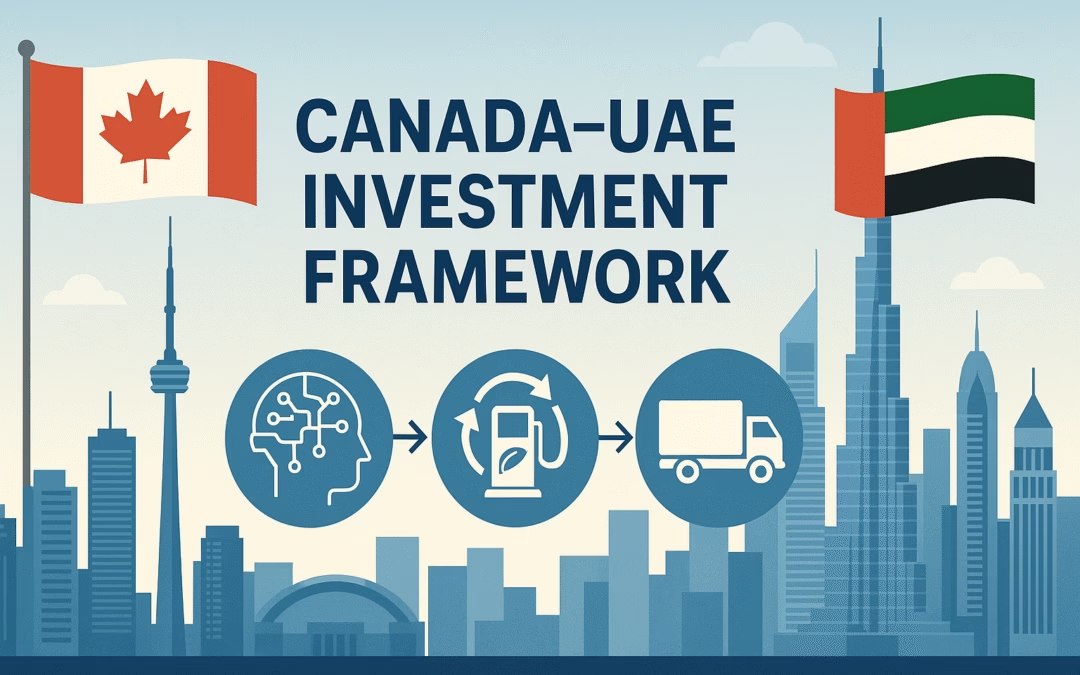
Canada and the United Arab Emirates have just taken a major step that will reshape capital flows, trade, and – importantly for you – talent flows between Canada and Dubai.
In late November 2025, Prime Minister Mark Carney and UAE leaders announced a new framework under which the UAE will invest up to US$50 billion in Canada, targeting strategic sectors such as artificial intelligence, energy, logistics, and critical minerals.Gulf News+1 At the same time, the two countries launched negotiations toward a Comprehensive Economic Partnership Agreement (CEPA) and signed a modern investment treaty aimed at cutting red tape and improving certainty for investors.Canada Prime Minister+1
For hiring managers in Canada and Dubai, this isn’t just another diplomatic headline. It’s an early warning that your markets are about to get more competitive, more international, and far more demanding on the talent side.
This article breaks down what the announcement actually means, which sectors are likely to heat up first, and how employers on both sides can get ahead of the curve instead of reacting late.
Quick recap: what was announced?
Recent government and media coverage highlight a few core elements of the Canada–UAE announcement:
Up to US$50 billion in new UAE investment into Canada under a dedicated framework, focused on AI, energy, logistics, mining, and other high-value industries.Gulf News+1
Launch of CEPA negotiations between Canada and the UAE, designed to cut tariffs, simplify customs procedures, and expand market access for goods and services.Canada Prime Minister+1
Priority collaboration in AI, digital innovation, FinTech, clean tech and sustainable energy, with explicit emphasis on research, commercialization, and responsible deployment.Canada Prime Minister
This sits on top of an already significant relationship:
Two-way merchandise trade reached CAD $3.4 billion in 2024, with the UAE as Canada’s largest export destination in the Middle East.Canada+1
Total Canada–UAE investment is estimated at over US$70.8 billion, reflecting deep, long-term capital commitments in both directions.Arabian Business+1
UAE FDI stock in Canada alone has been estimated around US$8.8 billion, with the new framework positioned as a step change from that base.qazinform.com+1
At a macro level, Canada has also been on a record run for foreign direct investment, attracting $85.5 billion in FDI in 2024, 50% above the 10-year average.investcanada.ca The UAE is now clearly signalling it intends to be a bigger slice of that pie.
Why hiring managers should care
When investment frameworks of this scale show up, three things tend to happen in labour markets:
Demand spikes ahead of supply. Capital is committed faster than talent pipelines can adapt. You get bidding wars for the right skill sets.
The definition of “local” talent changes. Employers get more comfortable with cross-border hiring, remote teams, and relocation in both directions.
Time-to-hire becomes a strategic risk. Being unable to staff critical roles on schedule becomes a board-level problem, not just an HR issue.
The Canada–UAE framework touches exactly the sectors that are already under talent pressure worldwide: AI, energy transition, logistics, critical minerals, digital infrastructure, and advanced financial services. This is not a gentle tailwind – it’s a multiplier on trends that were already reshaping hiring across the globe.
Sectors in Canada likely to see a hiring surge
1. Artificial intelligence, data centres, and digital infrastructure
The UAE’s investment framework specifically calls out AI and digital innovation, aligning with its global push into large-scale data centres and AI ecosystems.Reuters+1
For Canadian employers, expect increased demand for:
Machine learning engineers, data scientists, and applied AI researchers
Cloud and infrastructure engineers building large-scale data and compute platforms
Cybersecurity, governance, risk, and compliance professionals
Product managers and commercial leaders who can turn AI capabilities into revenue
This investment will not be limited to “pure tech” companies; banks, energy producers, logistics players, and manufacturers will all be competing for the same AI talent.
2. Energy, clean tech, and critical minerals
Canada’s energy producers, power utilities, and critical minerals firms are already central to global decarbonisation efforts. New UAE capital is expected to target energy projects and mining/critical minerals, with an emphasis on long-term returns and supply chain security.Gulf News+1
What this means for hiring:
A premium on engineers – mining, petroleum, chemical, and electrical
Project managers who can run multi-billion-dollar capital projects
HSE (health, safety, environment) and ESG professionals who can keep large projects bankable and compliant
Indigenous relations, stakeholder engagement, and regulatory affairs talent – especially in resource-rich provinces
The combination of capital intensity and regulatory complexity will favour candidates who understand both the technical and political dimensions of these sectors.
3. Logistics, trade facilitation, and supply chain
Canada is increasingly positioning itself as a secure, reliable node in global supply chains. The UAE, via Dubai and Abu Dhabi, is already a global logistics and aviation hub. The investment framework references logistics and other high-value industries as priority areas.Gulf News+1
Hiring implications:
Demand for logistics and supply-chain leaders who understand both North American and Gulf trade routes
Operations managers with experience in ports, airports, rail intermodal, and free-trade zones
Trade finance, customs, and compliance specialists
If CEPA delivers meaningful simplification of customs procedures, the volume of Canada–UAE trade will almost certainly rise – and so will the need for operational talent who can actually move goods efficiently.
4. Financial services and investment management
The UAE’s sovereign wealth platforms – such as Mubadala – are already active in Canadian financial services, including major deals like the acquisition of CI Financial, a large Canadian wealth and asset manager.CI Financial+1
As more Gulf capital flows into Canadian financial assets and platforms, expect:
Growing demand for portfolio managers, risk professionals, and product specialists with cross-border experience
Build-out of in-house corporate development and M&A teams
Talent needs in digital wealth, retail investing apps, and fintech infrastructure that support these investments
Where Dubai and the wider UAE will feel the talent crunch
This is not just a “Canada gets capital” story. As ties deepen, demand for talent in the UAE – especially Dubai and Abu Dhabi – will intensify in several areas:
Canadian-linked energy and infrastructure projects run from Dubai but executing globally.
AI, data, and cloud operations based in the UAE but serving North American clients.
Financial services and asset management hubs using Dubai as a base for managing Canadian and wider global portfolios.
Hiring managers in Dubai should expect more competition for:
Canadian-trained engineers, project managers, and energy professionals
Bilingual (English + French or English + Arabic) commercial leaders who can bridge stakeholders
Senior executives with experience operating in Canadian regulatory environments
For some roles, the most efficient solution will be Canadian professionals relocating to the UAE on medium-term assignments – which changes the playbook on relocation, housing, schooling, and family support packages.
Cross-border talent flows: Canada ↔ UAE
The CEPA negotiations and new investment treaty may eventually create more structured pathways for talent mobility – even if the details will take 12–18 months to finalize.VisaHQ+1
In practical terms, expect:
More project-based secondments where a Canadian team lead spends 6–24 months in Dubai, or vice versa.
Hybrid teams where core leadership is based in Canada but delivery is split between Canada, Dubai, and potentially third-country locations.
Increased use of employer-of-record (EOR) and global payroll models, as companies test markets before building full local entities.
For HR and talent acquisition, that means you will need:
Clarity on immigration options and timelines on both sides
Policies for remote/hybrid employees distributed across time zones (Toronto–Dubai is an eight- to nine-hour difference depending on daylight savings)
Compensation frameworks that account for cost-of-living differences, housing allowances, and tax treatment
Companies that wait until CEPA is fully implemented will be late. The competitive advantage comes from building your talent strategy while the agreement is still being negotiated.
Risks and complications employers should anticipate
Large cross-border investment flows are positive, but they come with challenges that HR leaders must factor in:
Wage inflation in scarce skill sets
AI, renewables, critical minerals, and trade finance talent were already scarce. Add a multi-billion-dollar investment wave, and the bidding environment becomes more aggressive. Internal equity and retention risk will follow.Reputational and ESG considerations
The UAE’s global investment footprint – including in Africa and other regions – has attracted scrutiny around labour rights and environmental impact.The Guardian+1
Canadian and UAE-based employers will face questions from boards, employees, and regulators about how these projects align with ESG commitments.Execution risk on megaprojects
When capital is abundant, the constraint becomes project management and operational discipline. Under-resourced project teams can turn a promising investment into a headline failure.Regulatory complexity
CEPA will simplify some aspects of trade, but it will not eliminate sector-specific regulations – especially in critical minerals, energy, and data governance. You will need talent who can navigate these complexities, not just technical experts.
What hiring managers should start doing now
Whether you are a VP in Calgary, a CHRO in Toronto, or a business unit leader in Dubai, there are a few practical moves to make immediately:
1. Map your exposure to Canada–UAE opportunity areas
Identify where your organization touches – or could touch – the sectors highlighted in the new framework:
AI & digital infrastructure
Energy, clean tech, and critical minerals
Logistics, aviation, ports, and trade facilitation
Financial services, wealth management, and fintech
For each business line, ask: If additional capital landed tomorrow, which roles would be the bottleneck?
2. Build talent heatmaps, not just job requisitions
Move from reactive requisitions to talent heatmaps:
Which skills (e.g., ML ops, power systems engineering, trade compliance) are most constrained in your geography?
Which roles are strategically critical but lack defined successors?
Where could cross-border hiring (Canada ↔ UAE) fill gaps faster than local-only recruitment?
This informs whether you should emphasize domestic recruitment, cross-border relocation, or remote-first models.
3. Strengthen your employer brand for cross-border talent
Top candidates in AI, energy, logistics, and finance will have no shortage of options. To win them, your employer brand must travel across borders:
Clear narrative on your involvement in Canada–UAE or broader MENA projects
Demonstrable commitment to safety, ESG, and long-term development
Competitive relocation and support packages for candidates moving between Canada and the UAE
4. Partner with recruiters who understand both markets
Generic hiring approaches will not work well in this environment. You will need partners who:
Understand Canadian and UAE labour markets, compensation norms, and candidate expectations
Can screen for technical excellence and cross-cultural adaptability
Are set up to manage multi-stakeholder processes (boards, sovereign investors, regulators, and local project sponsors)
How Axe Recruiting can support Canada–UAE hiring strategies
At Axe Recruiting, we’ve built our business around connecting high-growth organizations with the talent they need across borders – from executive leadership down to critical individual contributors. As Canada and the UAE deepen their economic partnership, we see three areas where we can create immediate value for hiring managers:
Sector-specific talent acquisition in AI, energy, logistics, and financial services roles tied to Canada–UAE initiatives.
Cross-border recruitment programs that help you design and staff teams across Canada and Dubai, including relocation, hybrid, and global-remote models.
Advisory support for workforce planning, so your hiring roadmap aligns with upcoming investment phases rather than reacting after the fact.
If you’re leading a business line in any of the sectors named in the new framework and you expect your mandate to grow, now is the time to stress-test your hiring strategy.
You can learn more about our work and connect with our team at:https://axerecruiting.com/
Further reading and external sources
For readers who want to go deeper into the underlying announcements and data:
Prime Minister of Canada – Prime Minister Carney secures new agreements with the United Arab Emirates Canada Prime Minister
Government of Canada – Canada deepens bilateral and trade ties with the United Arab Emirates Canada
Gulf News – UAE approves $50 billion investment framework with Canada Gulf News
Arabian Business – UAE and Canada investment hits $70.8bn as leaders advance CEPA talks Arabian Business