
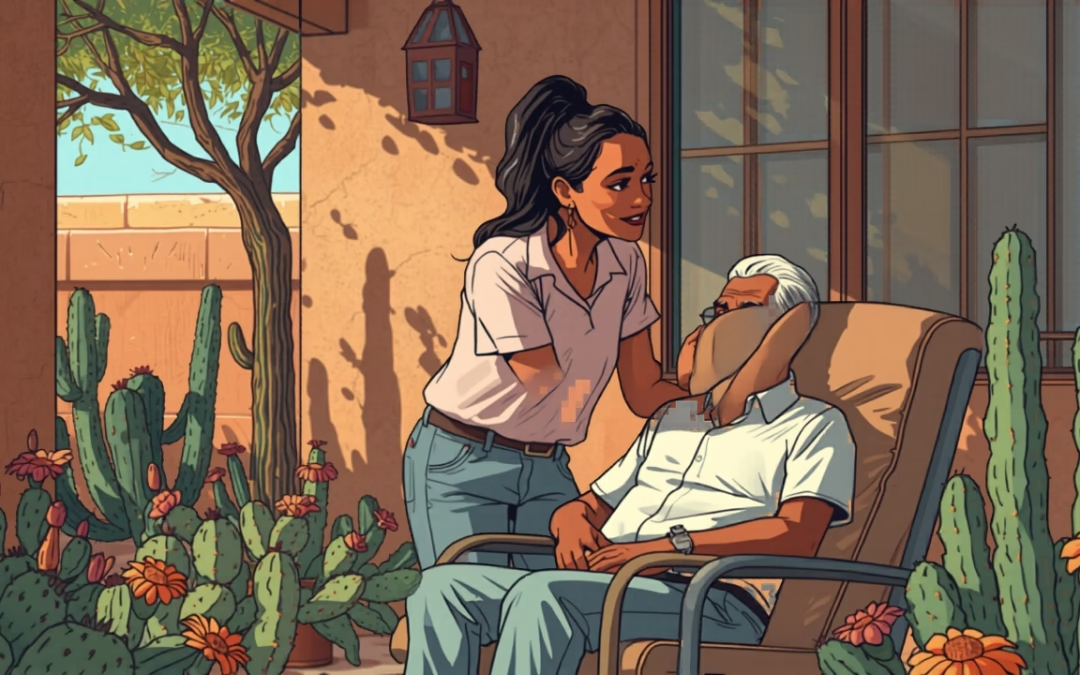
Arizona is graying faster than almost any other state in the country. Maricopa County — which encompasses Phoenix and the surrounding communities of Scottsdale, Tempe, Mesa, Chandler, Glendale, Peoria, and Gilbert — has one of the largest concentrations of residents aged 65 and older in the United States, and that population is growing year over year as retirees continue migrating from California, Illinois, and the Northeast in search of warm weather, lower costs, and a lifestyle that the Sun Belt reliably delivers. The projected growth of Arizona’s 65-and-over population through 2030 is among the steepest in the nation.
For home health agencies, in-home care providers, private duty care companies, and the post-acute networks that serve this population, the demand trajectory is not uncertain — it is a near-certainty. What is uncertain is whether the workforce will be there to serve it.
Home health and in-home care workforce recruitment in Phoenix in 2026 is a genuine operational challenge. The direct care worker shortage that affects markets across the country is particularly acute in a geography with this demographic profile, this service sector wage competition, and these physical working conditions. This guide is for home health and home care operators — whether you are a licensed home health agency under AHCCCS, a private duty operator, a national franchise branch, or a hospital-affiliated home care program — who want to build a workforce capable of meeting Phoenix’s growing care demand.
Why Phoenix is a uniquely challenging home health labor market
The heat creates real workforce constraints. This is a Phoenix-specific factor that operators from other markets often underestimate. During Arizona’s extreme heat months — which now reliably run from May through late September — the physical demands of care work conducted in non-air-conditioned environments, the hazards of client transport and community navigation in temperatures regularly exceeding 110°F, and the vulnerability of elderly clients to heat-related illness create specific operational and safety challenges. Direct care workers who are managing their own transportation in extreme heat, potentially without reliable A/C in their vehicles, face conditions that workers in other markets do not. Operators that acknowledge this explicitly — through scheduling adjustments, hydration and safety protocols, and honest communication — retain workers better through the summer months than operators who treat Phoenix’s climate as irrelevant.
Arizona AHCCCS creates specific payer and credentialing complexity. The Arizona Health Care Cost Containment System’s home health benefit — administered through managed care organizations including Mercy Care, Banner University Health Plans, and UnitedHealthcare Community Plan — creates a credentialing and authorization infrastructure that places administrative demands on both agencies and their staff. HHAs and CNAs working with AHCCCS-covered clients must meet specific training and certification requirements, and the authorization process for new clients can be a source of scheduling unpredictability that affects direct care worker satisfaction and retention.
Service sector wage competition is intense. Greater Phoenix is a large service economy with active hospitality, retail, logistics, and food service sectors that compete for the same entry-to-mid-level labor pool that home health agencies recruit from. Amazon’s fulfillment presence in the Phoenix metro, the large hospitality and resort sector in Scottsdale and the surrounding area, and year-round construction activity provide hourly alternatives for direct care worker candidates that are sometimes more lucrative and physically less demanding than home health work. Agencies that do not price their roles competitively with these alternatives will find their applicant flow declining.
Geographic sprawl creates logistics complexity. Phoenix’s metro footprint is enormous — driving from Surprise in the northwest to Chandler in the southeast is nearly an hour under normal conditions. Deploying home health aides across this geography requires both reliable personal transportation among the workforce and thoughtful geographic scheduling to prevent aides from spending disproportionate unpaid time driving between assignments. Agencies that solve the scheduling geography problem — clustering assignments by neighborhood, compensating meaningfully for mileage, and communicating clearly about drive time expectations — retain workers measurably longer.
Recruiting home health aides and CNAs in Phoenix
The direct care workforce recruitment challenge in Phoenix is fundamentally a marketing and speed problem. The candidates exist — there is a significant population of current and former CNAs, HHAs, PCAs, and caregiving-experienced individuals in Maricopa County — but they are being recruited simultaneously by multiple agencies and home care operators, and the ones who secure quality hires are the ones who reach candidates first and most compellingly.
Job posting optimization matters but is insufficient alone. Job boards — Indeed, ZipRecruiter, Facebook Jobs — do generate applicant volume for direct care roles in Phoenix. But the conversion rate from application to credentialed, working aide depends entirely on what happens after the click. Agencies with 24-hour contact response, clear and honest job descriptions, streamlined applications, and fast onboarding processes convert applicants to starts at significantly higher rates than agencies that let applications sit in an inbox for days before follow-up.
Spanish-language recruiting is non-negotiable for scale. The Hispanic and Latino population in Phoenix is not a niche demographic — it is approximately one-third of the metro’s total population, and within the direct care worker population, it is an even higher share. Agencies that conduct recruiting, onboarding, and ongoing communication only in English are accessing a fraction of their available labor pool. Spanish-language job postings, Spanish-speaking recruiters, bilingual onboarding materials, and supervisory support for Spanish-language staff are not optional add-ons for Phoenix home health operators — they are table stakes.
Referral programs are the highest-quality sourcing channel. The home care workforce in Phoenix has dense informal networks — workers know other workers, family members who might be good at caregiving, neighbors who are looking for work. Agencies that have simple, generous, fast-paying referral programs generate a sustained flow of referred candidates who typically outperform open-market hires on retention metrics. The failure mode for most referral programs is complexity and slow payment — simplifying the submission process and paying within two to four weeks of a referred hire reaching a milestone dramatically increases program utilization.
Community-based sourcing reaches candidates job boards miss. In Phoenix, community organizations, churches, community health workers, and workforce development programs in South Phoenix, Maryvale, and other dense residential neighborhoods maintain relationships with populations that are looking for stable employment but not actively browsing Indeed. Agencies that invest time in building community partnerships — through workforce development organizations, refugee resettlement agencies, community college workforce programs — access a sourcing channel with lower competition and higher loyalty.
Recruiting care coordinators and clinical leadership in Phoenix home health
Clinical and care coordination hiring in Phoenix home health presents different challenges from direct care recruitment. The candidate pool is smaller, more credentialed, and more actively recruited by hospital systems, ACOs, and behavioral health organizations simultaneously with home health agencies.
The Dignity Health, Banner Health, and HonorHealth systems — all major presences in the Phoenix metro — maintain their own home health programs and recruit from the same RN and LVN pool that independent home health agencies need. The competition for experienced RN case managers in Phoenix is significant, and agencies that approach these candidates with below-market compensation or unclear career development pathways lose them.
Current compensation benchmarks for Phoenix home health clinical and care coordination roles:
- HHA / home health aide: $15–$19/hour
- CNA (home health, Phoenix metro): $17–$22/hour
- LPN / LVN (field nurse or care coordinator): $52,000–$65,000
- RN case manager (home health): $80,000–$98,000
- Clinical supervisor / director of nursing (home health agency): $95,000–$125,000
- Director of operations / branch director: $80,000–$115,000 depending on scale
Agencies entering the Phoenix market from other geographies sometimes benchmark against California or New York rates and conclude that Phoenix compensation is "lower." While the base rates may be modestly lower on some roles, the competition for qualified candidates is sufficiently intense that agencies that attempt to hire at the floor of the Phoenix range rather than the midpoint routinely experience longer vacancies and higher turnover.
How Axe Recruiting supports Phoenix home health workforce strategy
Axe Recruiting works with home health agencies, private duty care operators, and hospital-affiliated home care programs across the Phoenix metro on both volume direct care recruitment and specialized clinical and operational hiring. We understand the AHCCCS landscape, the MCO credentialing requirements, the geographic deployment realities, and the competitive dynamics of the Phoenix home care labor market.
We are not a job board. We work proactively to source candidates who fit your specific operational model — whether you need bilingual CNAs for a Spanish-language client population in west Phoenix, an RN case manager with OASIS certification for a Medicare-certified agency, or a Director of Operations capable of scaling a multi-branch operation across the metro.
If you are trying to grow your home health workforce in Phoenix or fill a critical clinical or operational leadership role, we would welcome the conversation.
Contact Axe Recruiting to discuss your Phoenix home health staffing needs.