
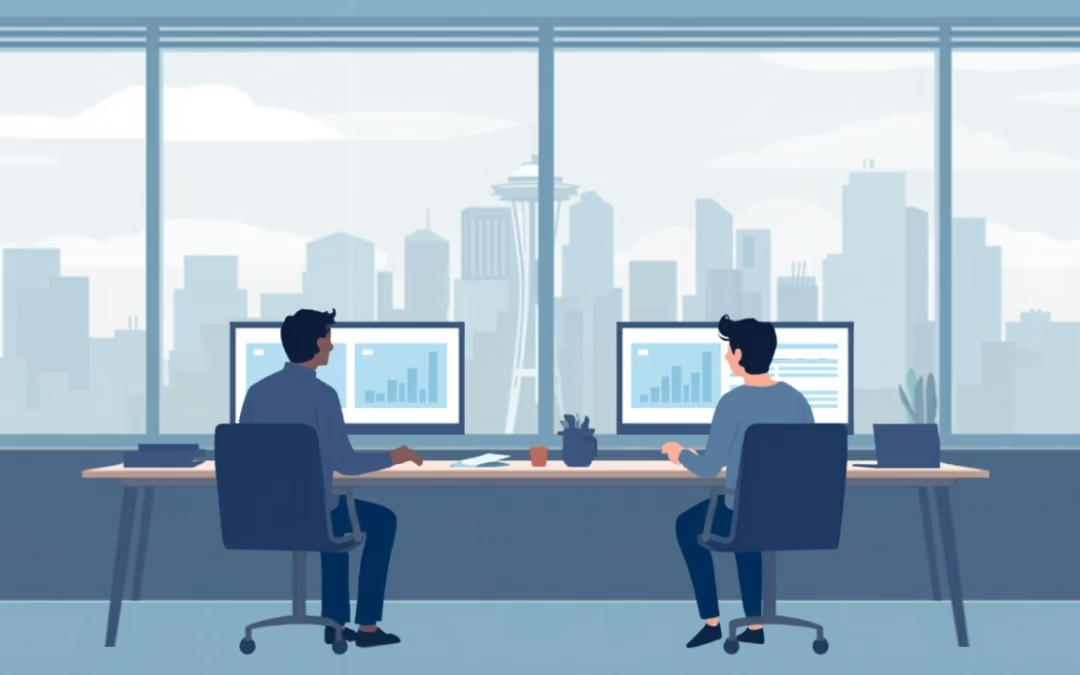
Seattle occupies a unique position in the American AI talent market. It is the only city in the country where two of the world’s largest AI employers — Amazon and Microsoft — maintain enormous engineering headquarters, each employing thousands of machine learning engineers, data scientists, and AI researchers. This creates a talent density that is second only to the Bay Area in terms of raw numbers of experienced AI practitioners — and it creates a recruiting dynamic that is unlike any other market in the country.
For any company trying to hire AI and ML talent in Seattle in 2026, the central challenge is not finding qualified candidates. The challenge is competing with Amazon and Microsoft for them. Both companies have scaled their AI hiring significantly in 2025 and 2026 — Amazon through Alexa AI, AWS AI services, and Amazon’s internal AI platform teams; Microsoft through Copilot, Azure AI, and the deep integration of OpenAI’s technology into Microsoft’s product stack. The compensation, brand recognition, and career development opportunities these companies offer create a gravitational pull that every other Seattle employer must reckon with.
The Seattle AI talent ecosystem in 2026
Amazon’s AI footprint is enormous and growing. Amazon’s investment in AI spans multiple dimensions: the Alexa and conversational AI team, AWS’s AI and ML services (SageMaker, Bedrock, and the growing suite of foundation model offerings), Amazon’s recommendation and personalization infrastructure, the advertising AI platform, and Amazon’s internal applied science and ML research organizations. The sheer volume of ML engineers at Amazon creates a large alumni network — engineers who have left Amazon for startups, other tech companies, or non-tech industries — that is one of the most important sourcing pools in Seattle’s AI market.
Microsoft’s OpenAI integration has reshaped its Seattle AI hiring. Microsoft’s deep integration of OpenAI’s models across its product portfolio — Copilot in Windows, Office, GitHub, and Azure — has driven a significant expansion of Microsoft’s AI engineering teams in Redmond and Seattle. Engineers who work on Copilot integration, Azure OpenAI Service, and Microsoft’s responsible AI frameworks are doing work at the frontier of applied generative AI, and Microsoft’s scale gives it a recruiting advantage over most Seattle-area competitors.
Seattle’s startup and growth-stage AI ecosystem is maturing. Beyond the hyperscalers, Seattle has a growing ecosystem of AI-native startups and growth-stage companies — in areas ranging from AI for scientific research to enterprise AI tooling to applied NLP — that compete for talent from Amazon and Microsoft’s alumni pools. The Seattle startup community benefits from the proximity of the two tech giants both as a talent source and as customers for AI products built by the startup ecosystem.
University of Washington is a top-10 AI research institution. UW’s Paul G. Allen School of Computer Science & Engineering is consistently ranked among the top AI research programs in the world. The Allen School’s AI labs — covering machine learning, NLP, computer vision, robotics, and human-computer interaction — produce graduates who are recruited by both the hyperscalers and the broader tech ecosystem. Companies that build relationships with UW’s AI research community gain early access to some of the country’s best ML engineering talent.
Key ML and AI roles in Seattle’s 2026 hiring market
ML engineer (AWS / cloud AI services) — Engineers who have built or operated AI and ML services at cloud scale — familiar with distributed training infrastructure, model serving at high throughput, and the engineering challenges of deploying ML capabilities as API services to millions of customers — are in high demand from both AWS competitors and enterprise companies building their own AI platforms. The AWS alumni community is one of the richest sources of this profile in the country.
Applied scientist / research scientist — Amazon and Microsoft both use the "applied scientist" title for a profile that combines research-level ML knowledge with engineering rigor — professionals who have typically completed a PhD in ML, statistics, or a related field and who work on novel ML problems with production impact. This profile is distinct from both the pure research scientist and the ML engineer and requires specific sourcing through academic networks and research publication communities.
Conversational AI / dialogue systems engineer — Seattle’s concentration of conversational AI work — Alexa, Cortana’s successors, and the growing ecosystem of voice and chat AI products — has created a specific talent pool with expertise in dialogue systems, speech recognition, intent classification, and the specific ML challenges of deploying conversational AI at scale. Engineers from this background are valued across industries as companies build customer-facing AI applications.
Recommendation systems engineer — Amazon’s recommendation infrastructure is among the most sophisticated in the world, and the engineers who have worked on it at scale — building candidate generation, ranking, and contextual bandits systems that operate across hundreds of millions of users — carry skills that transfer to virtually every consumer-facing product company. Seattle has a concentration of this expertise that no other market outside the Bay Area can match.
AI safety / responsible AI engineer — Microsoft’s significant investment in responsible AI — including its AI for Good research lab, its Responsible AI Standards framework, and the safety engineering work around Copilot and Azure AI services — has created a concentration of responsible AI practitioners in Seattle. As enterprise companies build their own AI governance capabilities, demand for engineers and researchers with responsible AI methodology experience has grown significantly.
Compensation benchmarks for Seattle AI and ML roles, 2026
Washington State has no state income tax, which effectively adds 5–10% to the value of cash compensation relative to California equivalents and is a genuine factor in candidate decision-making.
- ML engineer (3–5 years, Seattle): $230,000–$320,000 total comp
- Senior ML engineer (5–9 years): $310,000–$460,000
- Applied scientist / research scientist (PhD-level): $340,000–$530,000+
- Conversational AI / NLP engineer (senior): $280,000–$400,000
- Recommendation systems engineer (senior): $300,000–$430,000
- AI safety / responsible AI engineer (senior): $270,000–$390,000
- Director of ML / Head of AI (Seattle): $420,000–$620,000+
How non-Amazon, non-Microsoft companies recruit ML talent in Seattle
The companies that hire ML talent successfully in Seattle without the brand power of Amazon or Microsoft have identified specific competitive advantages and articulate them clearly.
The most effective pitch centers on technical impact and autonomy. Engineers at Amazon and Microsoft, despite working on world-class problems, often operate within large organizational structures with long decision cycles, substantial process overhead, and limited individual ownership of end-to-end ML systems. The startup or growth-stage company that can offer genuine technical ownership — where the engineer makes architectural decisions, sees their work ship to users, and has direct influence on the ML roadmap — is offering something that Amazon and Microsoft cannot match at scale.
Mission also matters. The engineers who leave Amazon and Microsoft to join startups or non-tech companies are often motivated by a desire to work on problems with more direct human impact — in healthcare, climate, education, or social impact domains. Companies in these sectors that can present a compelling mission narrative alongside competitive compensation consistently attract talent that the hyperscalers cannot retain.
Axe Recruiting works with technology companies, AI startups, and enterprise organizations in Seattle on ML engineering, applied science, data science, and AI leadership search. We understand the Seattle AI talent dynamics, maintain relationships with both the UW research community and the Amazon/Microsoft alumni networks, and bring sourcing depth that reaches the candidates most worth competing for.
Contact Axe Recruiting to discuss your Seattle AI and ML recruiting needs.