
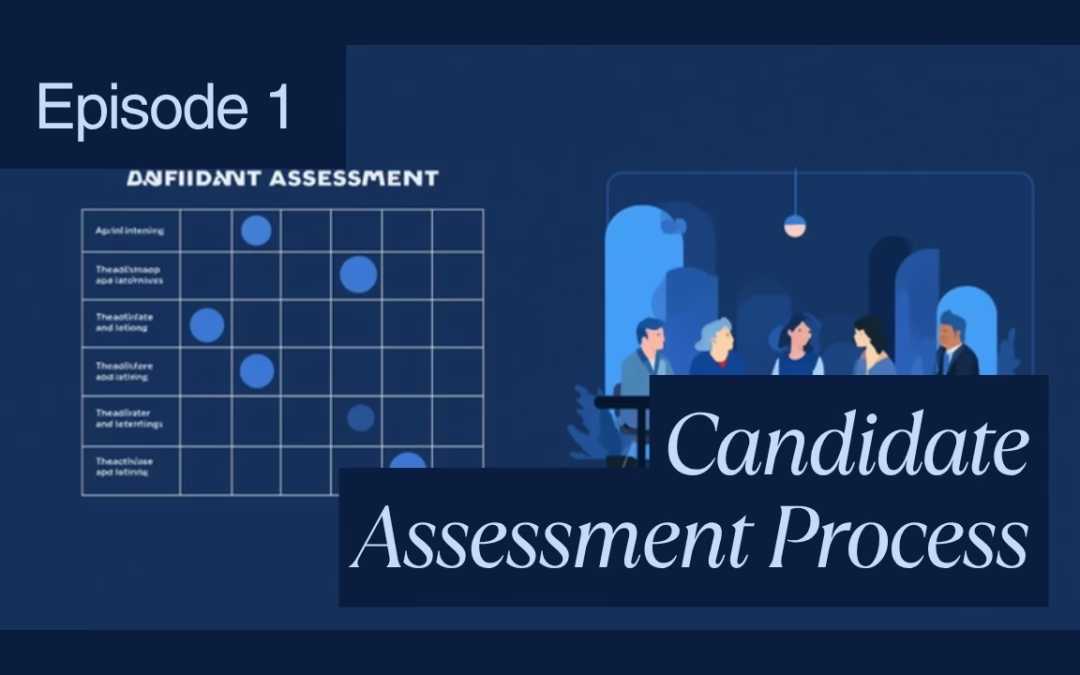
Most sales hiring scorecards are decorative. They exist to satisfy HR or look rigorous to investors, but they don’t change decisions. Real scorecards force calibration across interviewers, surface disagreement before offer, and predict attainment after hire. The difference between a working scorecard and a theater scorecard comes down to structure, not effort.
What a working scorecard does
Three jobs, in order of importance:
- Forces specificity: Vague impressions (“great communicator”, “strong culture fit”) get replaced with observable behaviors tied to job outcomes
- Calibrates across interviewers: A 4/5 from one panelist should mean roughly the same thing as a 4/5 from another
- Surfaces disagreement: When panel members score the same candidate 3 vs 5 on the same dimension, the gap forces a real conversation rather than averaged-out consensus
If your scorecard isn’t producing those three outcomes, it’s decoration.
The category structure that predicts attainment
For a quota-carrying sales role, five categories with weighted importance:
- Sales motion fit (30% weight): Does their experience match the motion you’re hiring for — SMB high-velocity, mid-market consultative, enterprise complex, channel-led? Pattern mismatch is the #1 predictor of failure
- Domain fluency (20%): Do they know the buyer, the language, the workflows, the competitive landscape?
- Operating rigor (20%): Pipeline hygiene, forecast accuracy, deal qualification discipline, CRM use, documentation
- Coachability and learning (15%): Can they take feedback, adapt their approach, learn the new product fast?
- Drive and resilience (15%): Will they sustain effort through tough quarters, recover from losses, hold up under pressure?
“Culture fit” is not a category. It’s a vague stand-in that smuggles bias into hiring. If you have real cultural requirements, break them into observable behaviors and rate them specifically.
The rating rubric
5-point scales work better than 4-point because they force differentiation. Anchored language matters more than the number:
- 1 = Concerning gap. Evidence suggests this dimension will be a problem in role
- 2 = Below bar. Some capability shown but won’t perform at the level needed
- 3 = Meets bar. Performs at the level the role requires
- 4 = Above bar. Performs above the level required; likely top-quartile
- 5 = Exceptional. Top 5% of candidates I’ve evaluated for this dimension
Avoid “meets expectations” language without specifying whose expectations. Anchor to the role, not the candidate’s career stage.
The evidence requirement
Every rating must include observable evidence:
- Specific examples from the interview, not general impressions
- Quotes when possible, especially for screening question responses
- Behavioral patterns vs single moments
- What was said vs what was demonstrated (these often diverge)
A 5 with no evidence is worth less than a 3 with strong evidence. Interviewers should write 2-3 sentences of evidence per dimension minimum.
The disagreement protocol
When panel scores diverge by 2+ points on the same dimension, the protocol:
- The high scorer and low scorer share evidence before the debrief
- Both explain their reasoning to the panel
- The hiring manager decides which interpretation is more credible
- Decision documented for future calibration
Averaging discordant scores produces false confidence. The disagreement IS the signal.
The categories most teams miss
- Pipeline math fluency: Can they articulate quota → coverage ratio → activity needed? Many candidates can’t
- Multi-thread comfort: Selling to 5-7 stakeholders concurrently differs from single-thread mid-market
- Loss reflection: How do they talk about deals they lost? Self-aware candidates discuss what they’d do differently; weak candidates blame buyers, marketing, or product
- Manager calibration: Can they describe what their best manager did differently? Reveals self-awareness about coaching needs
- Negotiation patterns: Do they hold pricing or discount reflexively? Watch their own offer negotiation as a signal
The mistake to avoid
Building a 30-criterion scorecard that no one fills out completely. Five dimensions filled rigorously beats twenty filled superficially. Optimize for evidence depth, not category breadth.
Hiring help
Axe Recruiting helps build hiring scorecards calibrated to the role and motion.
We design screening processes that predict attainment, not just produce paperwork.
→ Sales Recruiting
→ Start a conversation
Call (888) 340-3048 · [email protected]