
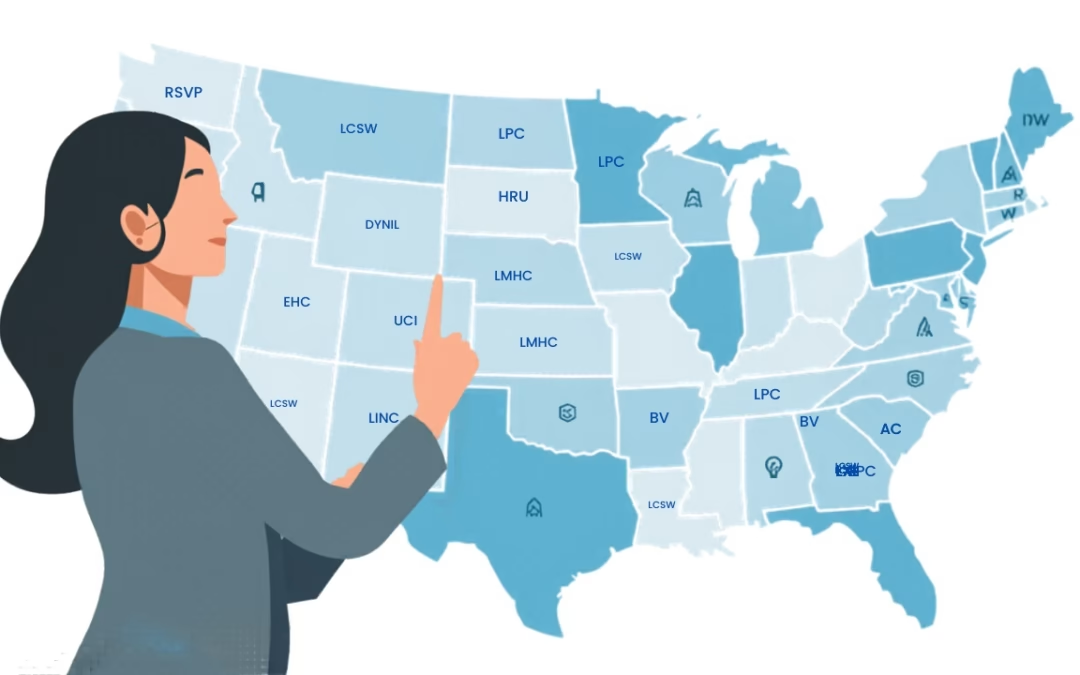
One of the most confusing aspects of behavioral health recruiting is the patchwork of state-specific licensure systems that govern where a clinician can practice, under what credential name, and with what scope of authority. The United States does not have a single national behavioral health license — each state has its own licensure system, its own credential names, its own supervised hours requirements, and its own scope of practice definitions. This creates real complexity for organizations recruiting across state lines and for clinicians considering relocation or multi-state practice.
This guide is a practical reference for behavioral health recruiters, HR leaders, and practice owners who need to understand how licensure varies across states and what that means for their hiring decisions.
The core credential categories and their state variations
Clinical social work: Most states license at two levels — a basic social work license (BSW-equivalent) and a clinical social work license that permits independent clinical practice. The clinical licensure title varies significantly: LCSW (Licensed Clinical Social Worker) is the most common; LICSW (Licensed Independent Clinical Social Worker) is used in Minnesota, Massachusetts, and some other states; LCSW-C (Licensed Certified Social Worker – Clinical) in Maryland; LISW (Licensed Independent Social Worker) in Ohio; and other state-specific variations. When sourcing candidates, always verify the specific credential title and scope in the state where they will practice.
Professional counseling: Licensed Professional Counselor (LPC) is the most common title, used in most states. However: Licensed Mental Health Counselor (LMHC) is used in New York, Florida, Massachusetts, Washington, and others; Licensed Clinical Mental Health Counselor (LCMHC) in North Carolina and New Hampshire; Licensed Professional Clinical Counselor (LPCC) in California and Minnesota; Licensed Clinical Professional Counselor (LCPC) in Montana, Maryland, Idaho; and additional state-specific variations. California’s LPCC and Minnesota’s LPCC are different credentials with different requirements despite the same name.
Marriage and family therapy: LMFT (Licensed Marriage and Family Therapist) is most common. California’s MFT (Marriage and Family Therapist) predates the LMFT designation in most other states and is essentially equivalent. The credential is less prevalent in some states where MFT training programs are less common.
Supervised hours requirements by state: what recruiters need to know
Supervised hours requirements before full independent licensure vary from approximately 2,000 hours (lower end, some states) to 3,500+ hours (higher end). This variation affects how long it takes a new graduate to achieve independent licensure and therefore how large the licensed vs. associate-level population is in any given state.
Higher hours requirements (3,000–3,500 hours): California, Texas, Illinois, New York, Georgia, North Carolina — these states have larger pre-licensure associate populations relative to their licensed populations, creating more associate recruiting opportunity but also more licensing timeline to manage.
Lower hours requirements (2,000–2,500 hours): Some states, including Colorado and parts of the Midwest, have lower requirements that create faster pathways to independent licensure and somewhat smaller pre-licensure pools.
Multi-state practice and licensure compacts
The Counseling Compact enables licensed LPC/LMHC-equivalent counselors to practice in compact member states without obtaining a separate license in each state. As of 2026, a growing number of states have enacted the compact. Clinicians with compact privileges can provide telehealth services across state lines under their home state license, which is significant for telehealth employers and clinicians.
The ASWB Social Work Compact (in implementation) is developing a similar compact for social workers that would allow multistate practice under a single compact privilege. Implementation timelines vary by state.
The Enhanced Nurse Licensure Compact (eNLC) covers registered nurses and licensed practical nurses; a separate APRN compact covers advanced practice nurses including PMHNPs and is in varying stages of adoption across states.
PMHNP practice authority: full vs. collaborative practice states
As of 2026, the majority of states have enacted full practice authority for nurse practitioners — allowing PMHNPs to assess, diagnose, and prescribe independently without a physician collaborative agreement. Full practice authority states include California, Washington, Oregon, Colorado, Minnesota, New Mexico, and others.
States that still require collaborative or supervisory agreements include Texas, Georgia, Florida, and others. This distinction significantly affects PMHNP recruiting — candidates in collaborative practice states ask immediately about the collaborative agreement arrangement, and organizations without a clear, established answer lose candidates.
Axe Recruiting maintains current working knowledge of state licensing requirements and compact participation across all states where our clients recruit, and provides guidance on licensing implications as part of every search engagement.
Let’s Talk — We’re Ready to Help
Axe Recruiting is a specialized staffing and executive search firm serving clients across North America and EMEA. Whether you need to fill one critical role or build an entire team, our recruiters bring deep market knowledge, active candidate networks, and the speed your hiring timeline demands.
🕑 Monday – Friday, 9am – 5pm EST • Serving the US, Canada & EMEA • axerecruiting.com/contact-us