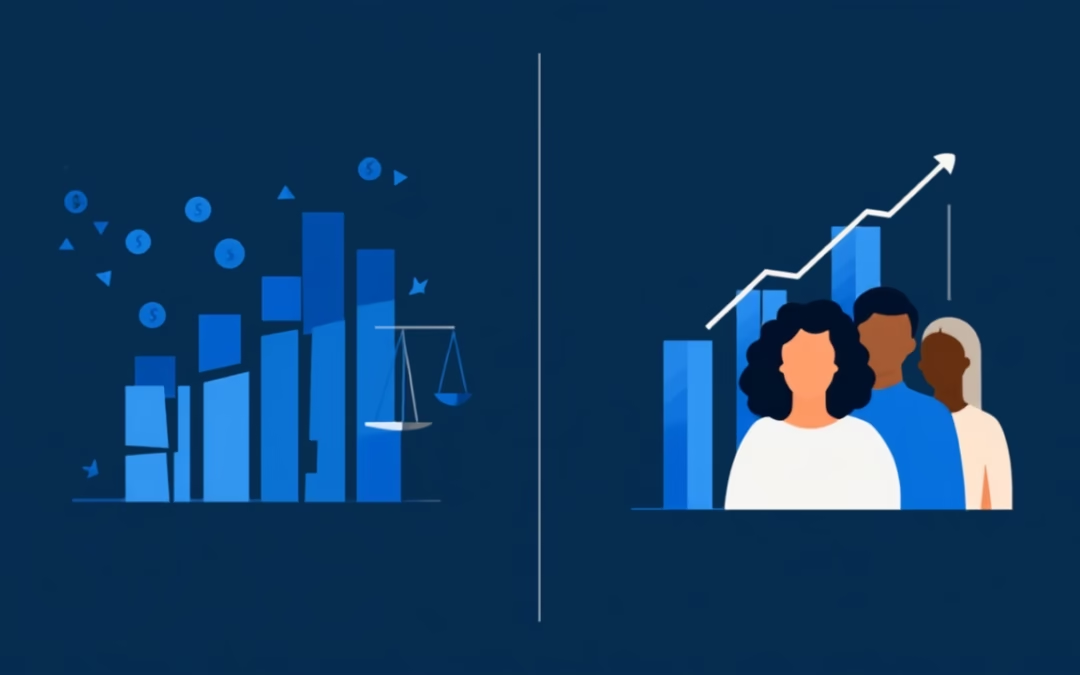
The ZIRP era reshaped sales comp in ways that didn’t survive the macroeconomic shift. Equity grants that made sense at 2021 valuations don’t make sense at 2026 valuations. OTE numbers that depended on inflated pipeline don’t hold when growth rates compress. Companies hiring against 2021 comp benchmarks in 2026 produce predictable outcomes — either overpaying and degrading unit economics, or underpaying and losing top candidates to competitors who’ve recalibrated. Understanding the post-ZIRP comp reality is essential.
What’s stable: base salary
Base salary numbers have held up remarkably well. The fundamental cost of living for sales talent in tech markets hasn’t compressed. Strong AE candidates still command $130K-$180K base at growth-stage SaaS. SDR base sits at $55K-$75K. CSM base at $90K-$130K. VP Sales base at $230K-$320K.
The base number tells you what a candidate can rely on regardless of attainment. That number has remained meaningful and roughly stable since 2022.
What’s stable: OTE for in-demand roles
OTE for in-demand roles has held up. Strong enterprise AE OTE is still $280K-$380K. Strong mid-market AE OTE is still $200K-$280K. The market continues to value high-performing sales talent because their economic contribution remains real and measurable.
What’s changed isn’t whether companies pay strong OTE — it’s whether candidates can actually achieve it. Quota attainment distributions are tighter, meaning fewer reps clear 100% of plan. The headline OTE matters less than the realistic earning expectation.
What’s compressed: equity grants
Equity has compressed materially. The 2021 environment produced equity grants that assumed continued valuation growth at 4-6x per round. With valuation expectations now closer to 2-3x per round (or sometimes flat), the math has shifted:
- Share counts at growth-stage SaaS are 30-50% smaller in 2026 than 2021 peaks for the same role
- Strike prices reflect more realistic valuation expectations
- Vesting acceleration on change-of-control is rarer
- Refresh grants are smaller and tied more tightly to performance
The net result: equity meaningfully contributes to total comp but is no longer the primary differentiator. The candidate who would have joined for the equity in 2021 wants more cash now.
What’s compressed: signing bonuses
Signing bonuses were inflated in 2021-2022 to compete in a hot talent market. They’ve largely compressed. Companies routinely offered $30K-$50K signing bonuses for senior AE roles in 2021. Current market is $10K-$25K, with some companies eliminating them entirely.
What’s compressed: forecast accuracy assumptions
The biggest hidden shift: companies are paying based on more realistic attainment assumptions. 2021 comp plans often assumed 90%+ of reps would hit plan based on inflated pipeline expectations. 2026 plans typically assume 50-60% will clear plan. The same headline OTE means a different expected payout.
What’s shifted: variable comp design
Variable comp design has shifted toward more discriminating accelerators:
- Lower payouts below quota threshold (more punitive on miss)
- Steeper accelerators above plan (more rewarding on overperformance)
- Tighter SPIFFs for specific strategic priorities
- More aggressive clawbacks on early-churn deals
- Equity refresh grants tied to specific performance milestones rather than tenure
What it means for candidate evaluation
Smart candidates in 2026 evaluate offers differently than they did in 2021:
- Heavier weight on base salary and OTE realism vs equity upside
- More scrutiny on company unit economics and runway
- Verification of recent attainment distributions at the offering company
- Understanding of comp plan design (caps, clawbacks, accelerator structure)
- Skepticism of equity valuations not backed by recent funding
What it means for hiring companies
- Don’t try to compete on 2021 equity packages — the math doesn’t support it
- Compete on base/OTE quality, plan design, and realistic attainment
- Be transparent about recent attainment distributions in interviews
- Invest in motion quality and pipeline coverage that make OTE achievable
- Equity should be meaningful but not the primary lever
The mistake to avoid
Building 2026 offers from 2021 templates. Companies that haven’t recalibrated their comp structure are either overpaying in equity (eroding their cap table) or underpaying in cash (losing candidates to better-calibrated competitors). Strong recent benchmarking is the foundation of competitive hiring in 2026.
Hiring help
Axe Recruiting benchmarks against current market comp \u2014 not 2021 nostalgia.
Current market data by role, stage, ACV band, and geography. We help companies make offers that win without overpaying.
→ Sales Recruiting
→ Start a conversation
Call (888) 340-3048 · [email protected]