
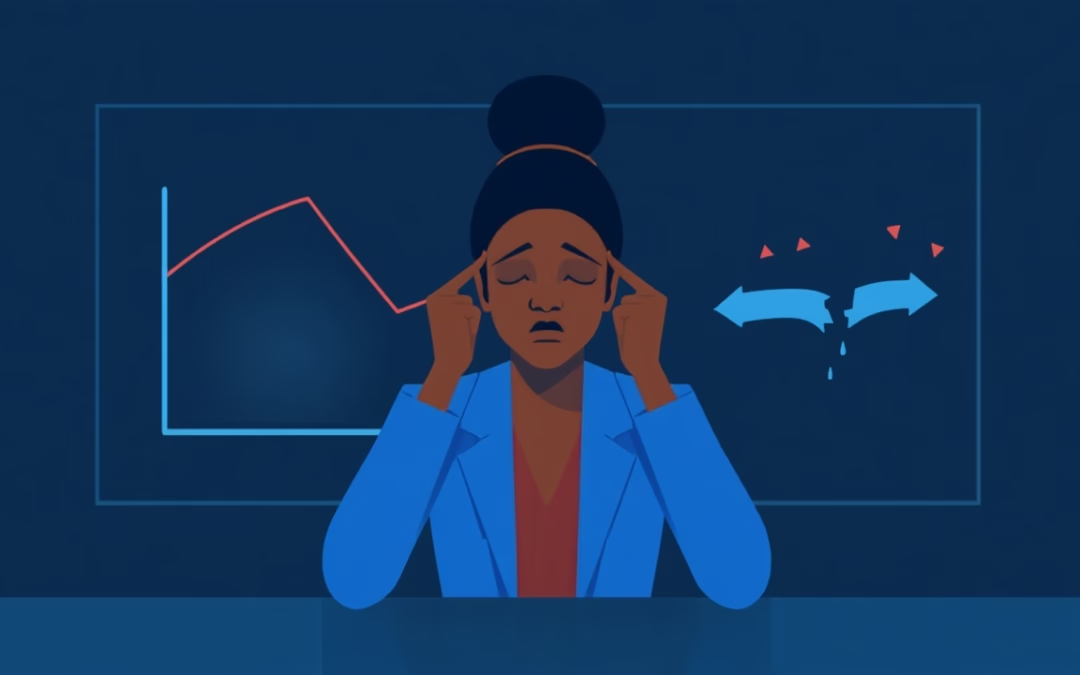
Across the SaaS industry, roughly 50% of VP Sales hires at Series B are out within 18 months. The reasons are remarkably consistent. Understanding the failure patterns matters not because all failed VP Sales hires can be saved — but because most of them are preventable at the hiring decision. Companies that diagnose the failure modes before they hire avoid the most predictable mistakes.
The five failure patterns
1. Stage mismatch. The most common failure mode. A VP Sales who scaled a Series D company arrives at Series B and tries to install Series D systems — heavy enablement, formal management cadences, deep ops infrastructure. The Series B environment can’t support it. Months pass building infrastructure while the team underperforms. CEO loses confidence. VP exits within 12 months.
2. Player-coach role mismatch. Series B requires the VP to still close deals — jump into late-stage opportunities, demonstrate the playbook, unblock procurement. Many senior VP Sales candidates have stopped selling years ago. They can manage and strategize but can’t execute. The team watches them stall in real deals and loses respect.
3. Founder-VP friction. The founder hired the VP to take over sales — but the founder also can’t let go. The VP can’t establish authority because the founder keeps jumping into deals, overriding decisions, recruiting reps directly. Six months of grinding misalignment. Both parties frustrated.
4. Wrong hiring profile. The VP hires reps who would have succeeded at their previous company but don’t fit the current stage. Too senior, too expensive, expecting more inbound than the company can produce. Six months later the new reps haven’t ramped. The VP gets blamed for hiring decisions that reflected the wrong calibration.
5. Forecast credibility loss. The VP commits to a number in month 3 to win the CEO’s confidence. The number misses by 30% in Q1. Confidence collapses. Every subsequent commit gets scrutinized. The relationship never recovers. VP exits.
What the failure pattern looks like in real time
- Months 1-3: Honeymoon. CEO impressed by strategic thinking and confident communication
- Months 4-6: Quarterly miss. CEO concerned but supportive. VP commits to course correction
- Months 7-9: Second quarterly miss. CEO actively concerned. Discussions with board about VP fit
- Months 10-12: Performance review. PIP or termination decision. VP exits
The pattern repeats so consistently that the timeline is nearly predictable. The diagnosis is too late by month 9 — the VP needed different support in month 2.
The early signals that predict failure
- VP spending too much time on internal restructuring versus customer-facing time
- VP making major comp plan or org changes in month 2 before understanding context
- VP hiring 4+ senior reps from previous companies without trying to integrate the existing team first
- VP unable to articulate specific deal-level coaching given to ICs
- Forecast accuracy degrading over time rather than improving
- Top reps from the existing team leaving in months 3-6
What CEOs can do to reduce failure rates
- Hire for stage match, not pedigree: A B+ Series B-experienced VP often outperforms an A Series D-experienced VP at Series B
- Clear handoff agreement: Define what the founder owns vs. what the VP owns, in writing, before the VP starts
- Realistic ramp expectations: 90 days for diagnostic, 6 months for visible improvement, 12 months for material results. Don’t compress this
- Weekly 1:1s in the first 6 months: Don’t disappear. The VP needs CEO context and CEO needs visibility into reality
- Board calibration: Brief the board on realistic VP ramp expectations so they don’t pressure premature judgment
What VP Sales hires can do
- Spend month 1 listening, not changing. Diagnose before treating
- Commit conservatively in month 3 — easier to beat than to miss
- Build trust with the founder by demonstrating field execution, not just strategy
- Don’t try to recreate your previous company at this company. Adapt
- Have explicit conversations about decision authority with the founder/CEO in month 1
The mistake to avoid
Treating every VP Sales failure as a hiring mistake. Sometimes the hire was right and the environment was wrong — unrealistic expectations, founder couldn’t let go, board pressured premature judgment. Diagnose the failure pattern carefully before drawing lessons. Companies that always blame the hire keep making the same hiring mistakes.
Hiring help
Axe Recruiting screens for stage-fit and runs CEO calibration before finalizing VP Sales hires.
Retained executive search with 12-month replacement guarantee. We diagnose failure-mode patterns before they happen.
→ Sales Leadership Recruiting
→ Executive Search
→ Start a conversation
Call (888) 340-3048 · [email protected]