Most tech founders get product right. They obsess over the tech stack, the roadmap, the pitch deck. Then they go to hire their first sales rep — and everything falls apart.
Not because they hired the wrong person. Because they didn’t have a process. They hired fast, skipped due diligence, and ended up with someone who looked great on paper but couldn’t sell water in a desert.
Here’s the hard truth: a bad sales hire at a startup doesn’t just cost you a salary. It costs you pipeline, momentum, runway, and in some cases — your best shot at product-market fit.
This guide breaks down exactly how to hire a sales team for a tech startup in 2026 — the right sequence, the right profiles, and the mistakes to avoid at every stage.
First: Don’t Hire a Sales Team. Hire a Sales Foundation.
The biggest mistake early-stage tech startups make is hiring a full sales team before they’ve validated their sales motion. You don’t need five reps. You need one exceptional, scrappy, full-cycle closer who can tell you whether your product actually sells.
Before making your first sales hire, you need to be clear on three things:
- Your ICP (Ideal Customer Profile): Who are you selling to? What’s their title, company size, industry, and pain point?
- Your sales cycle: Is this a 2-week transactional deal or a 6-month enterprise process? That determines whether you need a hunter or a relationship builder.
- Your ACV (Average Contract Value): This directly dictates compensation structure and the caliber of rep you can attract.
If you can’t answer those three questions clearly, you’re not ready to hire. You’re ready to do more discovery.
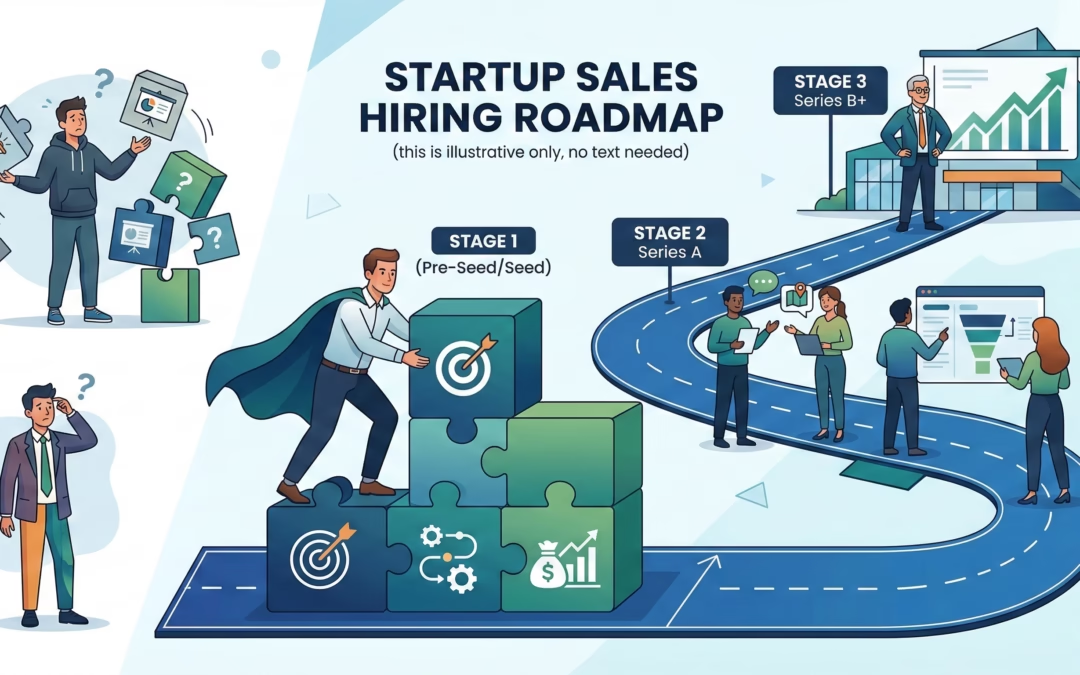
The Startup Sales Hiring Roadmap: Who to Hire and When
Here’s the hiring sequence we recommend at Axe Recruiting for tech startups going from zero to scale:
Stage 1 — Pre-Seed / Seed: The Founding AE (0–1 Sales)
This is your most important hire. Your first Account Executive needs to be a builder — someone who has sold in an ambiguous environment, has no playbook to rely on, and is energized (not intimidated) by that reality.
What to look for:
- Track record of success at an early-stage company (not just big-brand logos)
- Experience running the full sales cycle from cold outreach to close
- High EQ — they’ll be representing your brand before your brand is known
- Intellectual curiosity about your tech — they need to credibly speak to technical buyers
What to avoid: Hiring someone from a large enterprise who has only ever worked a warm inbound queue. That rep will struggle when the phone is cold and the brand is unknown.
Stage 2 — Series A: SDRs + a Second AE (1–5 Sales)
Once you’ve proven the model works — you have repeatable wins and a clear pattern of who buys and why — it’s time to build pipeline infrastructure.
Your SDRs (Sales Development Representatives) handle top-of-funnel prospecting, freeing your AEs to focus on closing. At this stage, you’re also hiring your second or third AE — ideally someone with complementary strengths to your first.
Key hiring criteria at this stage:
- SDRs: Coachability over experience. You’re still building the playbook — hire people who learn fast.
- AEs: Vertical expertise matters more now. If you’re selling into fintech, hire someone who’s sold there.
- Everyone: Cultural alignment. Early hires set the culture of your sales team for years to come.
Stage 3 — Series B+: VP of Sales or CRO (Building for Scale)
This is where founders typically under-hire. They promote their best AE into a leadership role when what they actually need is an experienced revenue operator who has built teams before.
Your VP of Sales or CRO needs to bring:
- Experience building and scaling teams of 10–50+ reps
- Ability to implement formal sales methodology (MEDDIC, Challenger, SPIN, etc.)
- Forecasting discipline and CRM hygiene
- A network of talent they can recruit from
A word of caution: hiring a VP of Sales too early is just as damaging as hiring too late. If you don’t have at least $1–2M ARR and a repeatable process, a senior sales leader will be frustrated by the lack of infrastructure and you’ll be frustrated by the cost.
The 5 Most Expensive Startup Sales Hiring Mistakes in 2026
1. Hiring for Resume Over Reality
A Salesforce or HubSpot pedigree doesn’t automatically translate to startup success. Those reps have brand, infrastructure, and warm inbound working for them. You have none of that yet. Prioritize demonstrated success in environments similar to yours — scrappy, high-growth, resource-light.
2. Rushing the Process Because You Need Revenue
Urgency is the enemy of quality hiring. A bad sales hire typically costs 3–5x their annual salary once you factor in lost deals, damaged relationships, and the time to rehire. Slow down to speed up.
3. Skipping Reference Checks
Salespeople are, by profession, excellent at selling themselves. References are non-negotiable. Talk to managers, not just peers. Ask specific questions about quota attainment, deal size, and what they would have done differently.
4. Ignoring Compensation Structure
Top sales talent knows their worth. If your OTE isn’t market-competitive or your variable comp plan is poorly designed, you’ll lose the best candidates to companies that have done their homework. Research market comps for your stage and geography before you open a role.
5. Not Defining Success Before You Hire
What does good look like at 30, 60, and 90 days? If you can’t answer that before the hire starts, you’ll struggle to evaluate their performance — and they’ll struggle to know what they’re working toward. Define the ramp expectations, quota, and milestones in writing before day one.
Should You Use a Sales Recruiter or Hire Internally?
This is a question we get constantly at Axe Recruiting. Here’s our honest answer:
If you’re hiring for AE roles at volume or for junior SDR positions and you have an internal HR function with recruiting bandwidth — build it in-house. The ROI is there.
But if you’re hiring for any of the following, a specialized sales recruiter pays for itself:
- Your first AE — the stakes are too high to get this wrong
- VP of Sales or CRO — you need access to passive candidates who aren’t on job boards
- Entering a new market — you don’t have the local network yet
- High-volume hiring sprint — when your internal team is at capacity
At Axe, every recruiter on our team has actually worked in the industries they recruit for. That means when we’re sourcing a VP of Sales for your SaaS startup, we’re not just reading job descriptions — we understand quota structures, GTM motions, and what a real top performer looks like from the inside. That’s a different kind of recruiting.
The Case for Recruiting-as-a-Service (RaaS) for High-Growth Startups
The traditional recruiting model — contingency or retained search, closed when the role is filled — was built for a world where hiring was linear and predictable. Tech startup hiring is neither.
That’s why more Series A and B companies are turning to Recruiting-as-a-Service (RaaS) — an embedded, ongoing recruiting partnership that scales with your needs. Instead of paying per hire, you get a dedicated recruiting function that plugs directly into your business.
The advantages are significant:
- Speed: No ramp-up time. Your recruiter already knows your culture, your roles, and your hiring bar.
- Cost efficiency: Dramatically lower per-hire cost at volume compared to traditional agency fees.
- Consistency: Same team, same standards, same process every time.
- Strategic input: A true RaaS partner advises on comp, org structure, and market conditions — not just sourcing.
What Great Sales Hiring Looks Like in Practice
Here’s a simplified framework we use at Axe Recruiting when placing sales talent at tech startups:
- Role scoping: We go deep on what success looks like in the role — not just the job description, but the behavioral profile of who will thrive.
- Passive sourcing: The best candidates aren’t applying to your job. We find them, build relationships, and make the case.
- Structured screening: We assess for the specific competencies your role requires — not just cultural fit and charisma.
- Offer management: We help you close the candidate, navigate counteroffers, and set expectations for the start.
- Post-placement support: The relationship doesn’t end at the offer letter. We check in to make sure the hire is performing and the client is satisfied.
The Bottom Line
Hiring a sales team for your tech startup is one of the highest-leverage things you’ll do as a founder. Get it right and you accelerate everything. Get it wrong and you burn cash, lose time, and set back growth by quarters.
The companies that scale fast aren’t just building great products. They’re building great teams — and they’re doing it with process, intentionality, and the right partners.
If you’re a tech founder looking to hire your first AE, build out your GTM team, or find a VP of Sales who can actually scale your revenue — Axe Recruiting specializes in exactly this. Our recruiters have sat in the seats your candidates are sitting in. We know the difference between a rep who interviews well and one who will close.
Reach out to Axe Recruiting today — and let’s build your sales team the right way.
‘Book a Free Consultation’
About the Author: Nathan Ware is the Founder of Axe Recruiting, a North American and EMEA recruiting firm specializing in Sales, Tech, Executive, and Finance placements for high-growth companies. Axe operates across Toronto, Montreal, Vancouver, Calgary, New York, Chicago, LA, Abu Dhabi, and Dubai.