
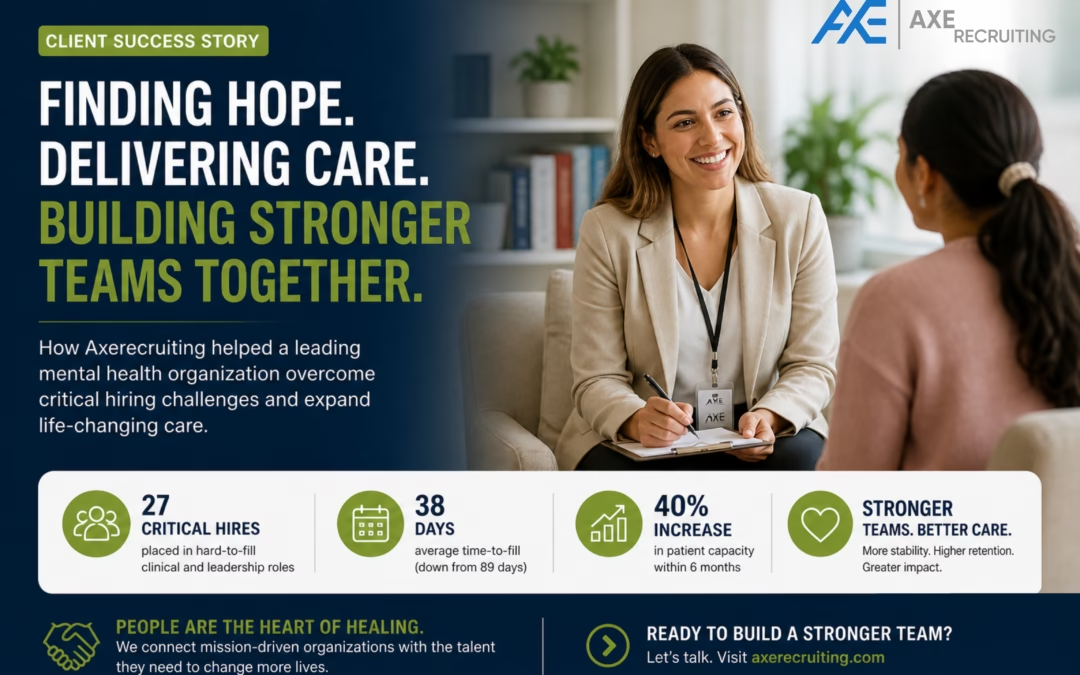
Key Takeaway: Mental health recruitment requires more than applicant flow. For specialized roles such as psychiatrists, psychiatric nurse practitioners, licensed clinical social workers, clinical leaders, business development professionals, and operations staff, healthcare organizations need a recruitment strategy built around direct sourcing, candidate qualification, compensation clarity, speed, and business alignment.
Hiring in mental health is not the same as hiring in most other industries.
The stakes are higher. The candidate market is tighter. The roles are more specialized. The hiring process requires a stronger understanding of licensing, compensation, clinical fit, patient care standards, and long-term organizational growth.
For growing mental health organizations, recruitment is not simply an HR function. It is a business-critical growth function.
When key clinical roles remain open, the impact can be felt across the entire organization. Patient access may slow down. Existing providers may feel stretched. Leadership may be forced to delay expansion plans. Referral relationships can suffer. Revenue opportunities can be missed. Most importantly, people who need care may have to wait longer to receive it.
This is why one growing mental health organization partnered with Axe Recruiting.
Over the past year, Axe Recruiting has supported the organization across multiple mission-critical searches, including psychiatrists, psychiatric nurse practitioners, licensed clinical social workers, business development professionals, medical leadership, and clinical operations support.
This case study outlines the challenge, the strategy, and the broader lessons for healthcare and mental health organizations looking to build stronger teams in a competitive talent market.
The Challenge: More Than Resumes
The client was not simply looking to fill jobs.
They were building clinical capacity.
They needed qualified professionals who could help support patient care, operational growth, community outreach, and long-term service expansion.
The client required recruitment support across several categories, including:
- Psychiatrists
- Psychiatric-Mental Health Nurse Practitioners
- Licensed Clinical Social Workers
- Medical and clinical leadership
- Business development and referral growth professionals
- Care coordination and administrative support
- Interventional psychiatry support roles
- Clinical operations staff
Each of these searches required a different recruitment strategy.
A psychiatrist does not evaluate a role the same way a business development manager does. A psychiatric nurse practitioner has different priorities than an administrative coordinator. A licensed clinical social worker may care deeply about caseload development, clinical support, flexibility, payer mix, documentation requirements, and long-term earning potential.
That is where many healthcare organizations struggle.
They often attempt to use the same job posting, same pitch, same interview process, and same compensation explanation across very different roles. That approach may produce applicants, but it rarely produces consistent, high-quality hiring outcomes.
Axe Recruiting’s role was to help the client build momentum across these searches with a more structured, specialized, and market-aware approach.
Why Mental Health Recruitment Is Uniquely Difficult
Mental health recruitment is one of the more challenging areas of healthcare hiring because the best candidates are often difficult to reach, difficult to move, and highly selective.
The candidate pool is limited by licensing, clinical specialization, state requirements, compensation expectations, and professional fit. In many cases, the strongest candidates are already employed and are not actively applying to job postings.
This creates several challenges for employers.
Organizations need to identify candidates who are properly licensed and clinically qualified.
They need to communicate the opportunity clearly enough to generate interest from candidates who may already have stable employment.
They need to explain compensation, benefits, schedule expectations, patient population, clinical model, administrative support, and long-term growth potential in a way that builds trust.
They also need to move quickly. Strong candidates in healthcare do not stay available for long.
Finally, mission matters. Mental health professionals often care deeply about quality of care, leadership support, clinical environment, and the population being served.
A generic recruitment process is not enough.
Mental health organizations need a strategy that combines direct sourcing, market knowledge, candidate qualification, compensation positioning, and strong communication.
The Axe Recruiting Approach
Axe Recruiting approached the engagement as a long-term recruitment partnership rather than a transactional search.
The goal was not simply to send resumes.
The goal was to support the client’s broader hiring infrastructure and help the organization compete for specialized talent in a difficult market.
The approach included direct candidate sourcing, role-specific market mapping, candidate qualification and screening, compensation expectation alignment, candidate education, interview coordination, offer support, feedback management, ongoing recruitment process improvement, and strategic hiring consultation.
Axe Recruiting worked to understand the client’s business model, clinical environment, hiring priorities, patient population, compensation structures, and growth plans.
That understanding allowed the team to tailor the recruitment approach by role.
In healthcare recruitment, success often depends on the recruiter’s ability to understand not only who the client wants to hire, but why that hire matters to the business.
Psychiatrist Recruitment
Psychiatrist recruitment is highly competitive.
Qualified psychiatrists are in demand across private practices, hospitals, outpatient clinics, telehealth providers, community health organizations, academic institutions, and specialty mental health groups.
That means candidates often have options.
For this client, Axe Recruiting focused on positioning the psychiatrist opportunity around more than compensation alone.
The recruitment message had to communicate the organization’s mission, clinical environment, patient population, leadership structure, schedule expectations, compensation model, available support, growth opportunity, and long-term value of joining the organization.
This type of search requires credibility.
Psychiatrists are highly trained professionals. They do not respond well to vague or generic outreach. They need to understand the role, the patient population, the clinical expectations, and why the opportunity is worth considering.
Axe Recruiting’s strategy was to present the opportunity clearly, handle candidate questions directly, and ensure the client was speaking with candidates who had been properly qualified before entering the interview process.
Psychiatric Nurse Practitioner Recruitment
Psychiatric-Mental Health Nurse Practitioners are essential to many modern mental health organizations.
They help expand patient access, support clinical capacity, and create a more scalable care model. However, PMHNP recruitment is also competitive, especially when candidates have options across telehealth, outpatient care, private practice, hospitals, and hybrid clinical environments.
For this client, Axe Recruiting focused on identifying candidates whose experience, availability, compensation expectations, and clinical philosophy aligned with the organization.
The screening process considered whether the candidate was properly licensed, had relevant psychiatric or mental health experience, wanted full-time, part-time, hybrid, or flexible work, had compensation expectations aligned with the market, understood the patient population, was comfortable with the clinical model, and was likely to stay and grow with the organization.
This helped reduce wasted interviews and improved the quality of candidate conversations.
For healthcare organizations, this matters.
A bad interview process burns time. A poorly qualified candidate creates distraction. A misaligned offer creates frustration. A strong recruitment process protects everyone’s time and increases the likelihood of a successful hire.
Licensed Clinical Social Worker Recruitment
Licensed Clinical Social Workers play a central role in mental health care delivery.
However, recruiting LCSWs requires a strong understanding of clinical expectations, compensation models, payer environments, supervision structures, caseload development, and candidate motivation.
For this client, Axe Recruiting supported recruitment involving licensed clinical social workers and related clinical therapy roles.
These candidates often evaluate opportunities based on more than pay.
They want to understand how quickly they can build a caseload, what type of patients they will support, whether the role is in-person, hybrid, or remote, what administrative support is available, what documentation requirements exist, how compensation changes over time, whether benefits are available, what the leadership environment is like, and whether the organization is stable and growing.
Axe Recruiting helped communicate these details in a way that made the opportunity easier for candidates to understand.
In mental health recruitment, clarity is one of the most important tools.
When candidates do not understand the compensation structure, schedule, caseload expectations, or long-term opportunity, they hesitate. When they hesitate, the process slows. When the process slows, employers lose candidates.
A strong recruitment partner helps prevent that.
Medical and Clinical Leadership Recruitment
Clinical leadership roles require a different recruitment strategy than frontline clinical positions.
A Medical Director or senior clinical leader must bring more than technical credentials. They must bring judgment, leadership, credibility, operational awareness, and the ability to support both patient outcomes and organizational growth.
For growing mental health organizations, these roles can influence clinical standards, provider performance, patient care quality, regulatory alignment, service expansion, team morale, clinical workflows, and long-term strategy.
Axe Recruiting supported the client in thinking through the market, candidate expectations, compensation considerations, and positioning for senior clinical talent.
This type of search requires a more consultative approach.
The candidate must be evaluated not only for credentials, but for leadership fit, communication style, philosophy of care, business maturity, and ability to support a scaling healthcare organization.
That is why executive-level healthcare recruitment cannot be treated like a standard job posting.
It requires direct outreach, careful qualification, and a deeper understanding of what the organization is truly trying to build.
Business Development Recruitment
A mental health organization does not grow only by hiring clinicians.
It also needs strong business development, referral partnerships, community relationships, and local market presence.
Axe Recruiting supported recruitment for business development talent connected to healthcare growth.
This search required a different lens.
The right candidate could not simply be a generic salesperson. They needed to understand relationship-driven growth, referral sources, healthcare partnerships, community outreach, patient access, and the importance of trust in mental health services.
In healthcare, business development is not just about selling.
It is about building credibility with referral partners, community organizations, healthcare providers, and potential institutional relationships.
A strong business development hire can help support referral growth, partnership expansion, community visibility, patient volume, service awareness, revenue development, and market credibility.
For growing mental health organizations, this role can become a major driver of expansion.
Axe Recruiting helped position the opportunity accordingly and identify candidates who were more aligned with relationship-based healthcare growth than short-cycle transactional sales.
Clinical Operations and Administrative Support Recruitment
Not every critical hire carries a senior title.
In healthcare, administrative and care coordination roles can have an enormous impact on patient experience, provider efficiency, and operational performance.
For this client, Axe Recruiting supported roles tied to clinical operations, care coordination, and interventional psychiatry support.
These roles required candidates who could support patients, manage schedules, coordinate clinical workflows, communicate clearly, and operate with attention to detail in a healthcare environment.
The importance of these roles should not be underestimated.
When administrative operations are weak, clinicians feel it. Patients feel it. Leadership feels it.
A strong clinical operations hire can help improve patient scheduling, care coordination, documentation flow, insurance-related processes, provider support, patient communication, clinic efficiency, and service delivery.
Axe Recruiting treated these roles with the same level of seriousness as higher-compensation searches because the operational impact was meaningful.
The Strategy: Recruitment Built Around the Client’s Real Growth Plan
The most important part of this success story is that the recruitment strategy was tied to the client’s actual business need.
This was not a resume-forwarding exercise.
Axe Recruiting worked to understand what the client was building, where the pressure points existed, and which roles would create the most impact.
The strategy changed depending on the role.
For scarce clinical talent, the focus was direct sourcing, credibility, compensation clarity, and clinical alignment.
For leadership roles, the focus was market mapping, senior-level positioning, and deeper qualification.
For business development roles, the focus was healthcare relationship-building, referral growth, and commercial maturity.
For administrative and care coordination roles, the focus was operational fit, communication skills, reliability, and healthcare environment experience.
This is what effective recruitment should look like.
The process should reflect the role, the market, and the business outcome.
What Made the Partnership Work
Several factors made the engagement successful.
Long-Term Alignment
Axe Recruiting was not brought in for a single isolated hire.
The relationship developed around ongoing hiring needs, which allowed Axe Recruiting to better understand the client’s culture, operating model, compensation philosophy, and clinical priorities.
That kind of familiarity improves recruitment quality over time.
Role-Specific Search Strategy
Each role was treated differently.
The same sourcing message, screening process, and candidate pitch were not applied across every search. Axe Recruiting adjusted the approach depending on the market, urgency, seniority, and candidate profile.
Clear Candidate Communication
In healthcare recruitment, candidates need clarity.
They want to understand compensation, schedule, benefits, expectations, licensing requirements, patient population, and long-term potential.
Axe Recruiting helped communicate these details in a way that made candidate conversations more productive.
Stronger Qualification Before Submission
The goal was not to overwhelm the client with resumes.
The goal was to submit candidates who had been meaningfully screened and were worth the client’s time.
That distinction matters.
Business-Level Understanding
Axe Recruiting looked at the roles through a business lens.
The question was not only, “Can this person do the job?”
The question was also, “How does this hire support the client’s growth, patient access, operations, and long-term stability?”
That is the difference between recruiting as a service and recruiting as a strategic function.
Lessons for Healthcare and Mental Health Organizations
This client success story offers several important lessons for other healthcare and mental health organizations.
Passive Hiring Is Not Enough
Posting a job and waiting for applicants may work for some roles, but it is rarely enough for specialized healthcare hiring.
The strongest candidates are often already working. They need to be identified, approached, educated, and guided through the process.
Compensation Must Be Clear
Healthcare candidates want to understand the full compensation picture.
That includes salary, hourly rates, benefits, bonus potential, ramp-up structure, productivity expectations, schedule, and long-term earning potential.
Vague compensation creates hesitation.
Clear compensation creates momentum.
Speed Matters
The hiring process must move quickly.
If a candidate waits too long for feedback, scheduling, next steps, or an offer, they may move on. In a competitive healthcare market, speed is not a luxury. It is part of the recruitment strategy.
Mission Matters
Many mental health professionals are deeply mission-driven.
They want to know who they are serving, how care is delivered, what support exists, and whether the organization’s values align with their own.
A strong recruitment process communicates mission clearly.
Every Role Needs Its Own Search Strategy
A psychiatrist, PMHNP, LCSW, medical director, business development manager, and care coordinator cannot all be recruited the same way.
Each candidate market has different motivations, concerns, and decision-making factors.
Recruitment Is a Growth Function
For healthcare companies, recruitment affects far more than headcount.
It affects patient access, revenue, service delivery, provider workload, leadership capacity, and market expansion.
Hiring is not separate from growth.
Hiring is part of growth.
The Business Impact of Better Healthcare Recruitment
When healthcare recruitment is done properly, the organization gains more than employees.
It gains capacity.
It gains stability.
It gains the ability to serve more patients, support existing staff, grow referral relationships, and execute on expansion plans.
For a mental health organization, this is especially important.
Every open clinical seat represents more than a vacancy. It can represent delayed care, increased pressure on existing providers, missed revenue, and slower organizational momentum.
A stronger recruitment process helps solve those issues.
It gives leadership a more reliable path to build the team they need.
Why Companies Choose Axe Recruiting
Axe Recruiting works with organizations that need more than applicant flow.
The firm supports companies that need qualified, properly screened, well-matched candidates for roles that matter.
Axe Recruiting brings a practical, business-minded approach to recruitment across healthcare, sales, technology, operations, leadership, and other specialized functions.
The firm’s work is built around direct sourcing, market understanding, candidate engagement, role-specific strategy, clear communication, client alignment, speed, execution, and long-term partnership.
For hiring managers, executives, and founders, this matters.
The right recruitment partner does not simply send names.
The right recruitment partner helps solve hiring problems that affect the business.
Final Takeaway
Mental health organizations are operating in one of the most important areas of healthcare.
The demand for quality care continues to grow, but organizations cannot scale care without the right people.
This client success story shows what is possible when recruitment is treated as a strategic growth function.
With the right search strategy, clear candidate communication, market understanding, and disciplined execution, even difficult healthcare searches can move forward with confidence.
For organizations hiring psychiatrists, psychiatric nurse practitioners, licensed clinical social workers, medical directors, business development professionals, or clinical operations staff, the lesson is clear:
The talent market is competitive.
The process matters.
The message matters.
The recruitment partner matters.
And when the right people are hired, the impact reaches far beyond the job description.
It reaches the patients, the providers, the leadership team, and the future of the organization.
Work With Axe Recruiting
If your organization is struggling to hire specialized healthcare, mental health, sales, operational, technical, or leadership talent, Axe Recruiting can help.
We work with companies that need a serious recruitment partner capable of understanding the role, the market, the candidate pool, and the business outcome behind every search.
Visit: https://www.axerecruiting.com
Book a consultation: https://calendly.com/axerecruiting/30min
Axe Recruiting — Your Search Stops Here.
Frequently Asked Questions
What is a mental health recruitment agency?
A mental health recruitment agency helps healthcare organizations identify, attract, screen, and hire qualified professionals for behavioral health and mental health roles. These may include psychiatrists, psychiatric nurse practitioners, licensed clinical social workers, therapists, medical directors, care coordinators, and operational support staff.
Why is mental health recruitment difficult?
Mental health recruitment is difficult because many roles require specialized licensing, clinical experience, strong patient-care alignment, and market-competitive compensation. Many qualified candidates are already employed and need to be directly sourced and properly engaged.
How can a healthcare organization recruit psychiatrists more effectively?
Healthcare organizations can recruit psychiatrists more effectively by using direct sourcing, clear compensation information, fast interview processes, strong clinical positioning, and a recruitment message that explains the opportunity with detail and credibility.
Does Axe Recruiting recruit healthcare professionals?
Yes. Axe Recruiting supports healthcare and mental health organizations with recruitment for clinical, operational, sales, leadership, and specialized roles.
What healthcare roles can Axe Recruiting help fill?
Axe Recruiting can support searches for psychiatrists, psychiatric nurse practitioners, licensed clinical social workers, medical directors, business development managers, care coordinators, administrative support roles, and other specialized healthcare positions.