
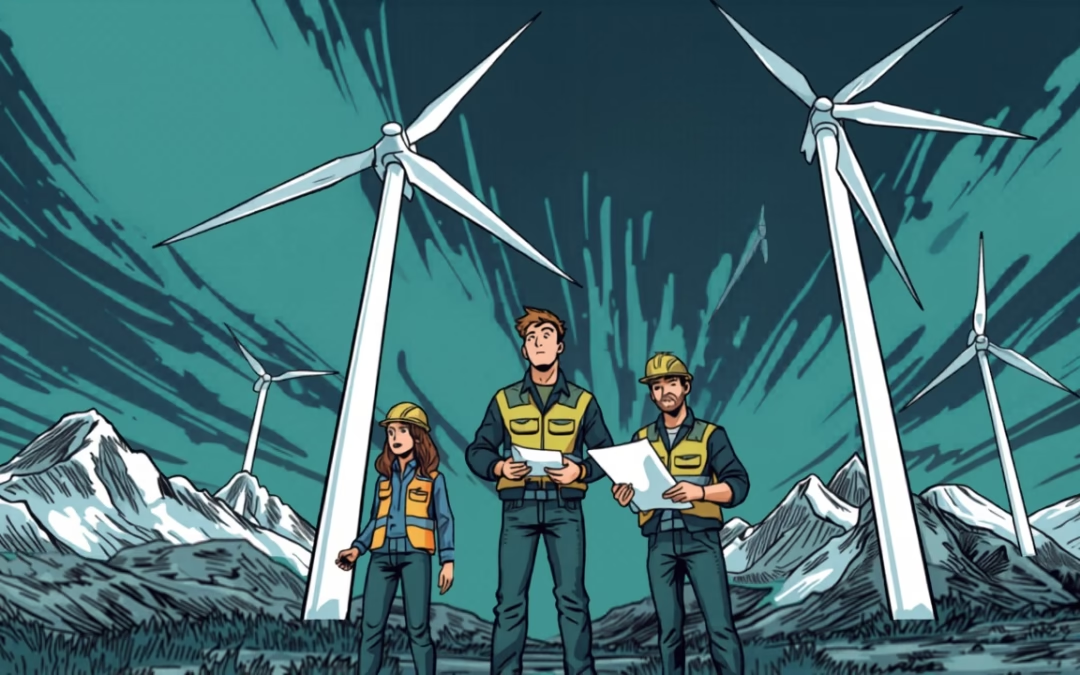
Colorado sits at the intersection of two of the most powerful forces in American energy: the wind-rich Great Plains and Front Range corridor that has made the state one of the top wind generation markets in the country, and a rapidly maturing battery storage and grid modernization ecosystem that is scaling fast under the dual pressure of Xcel Energy’s clean energy commitments and the federal investment catalysts created by the Inflation Reduction Act. Denver has emerged as the operational and corporate hub of this activity — home to the regional offices of national developers, the headquarters of several clean energy companies, and a concentration of engineering, finance, and policy talent that makes it one of the most important clean energy labor markets in the Mountain West.
For companies hiring in Denver’s wind and storage sector in 2026, the challenge is not awareness of the talent pool. It is access to it. The best wind energy engineers, battery storage integration specialists, and clean energy project managers in Denver are typically employed, productive, and not browsing job boards. Reaching them requires a different approach.
Colorado’s wind and storage market: what’s driving hiring in 2026
Xcel Energy’s clean energy transition is the anchor driver. Xcel has committed to 100% carbon-free electricity by 2050 and has an aggressive near-term renewable portfolio standard that is driving a sustained procurement cycle for wind, solar, and storage. The size and creditworthiness of Xcel as an offtaker gives developers the bankability to finance large projects — and to hire the teams to build them.
The IRA’s production tax credit extension has unlocked a new generation of wind projects. The extension and expansion of the production tax credit for wind under the Inflation Reduction Act has brought a wave of previously marginal projects into financial viability. Wind development across eastern Colorado, Wyoming, and the broader Rocky Mountain corridor is accelerating, and the project management and engineering talent required to execute these projects is being drawn from a labor market that was already tight.
Battery storage is growing faster than the workforce to support it. Colorado has seen rapid growth in grid-scale battery storage deployment — both standalone BESS projects and co-located wind-plus-storage and solar-plus-storage facilities. The engineering disciplines required for BESS projects — power electronics, thermal management, battery management system integration, SCADA, and commissioning — are specialized enough that the qualified candidate pool nationally is limited. In Denver, which is a secondary market for BESS talent relative to California and Texas, the shortage is particularly acute.
Denver’s clean energy corporate ecosystem is creating lateral competition for talent. The concentration of clean energy companies in Denver — from national developers like RWE and Enel Green Power to Colorado-based independents and the regional offices of large utilities — means that engineers and project managers are being recruited simultaneously by multiple organizations. A wind engineer who leaves one company in Denver’s LoDo office district is typically fielding calls from three competitors within a week.
Key roles and recruiting challenges in Denver wind and storage
Wind energy project manager — The project management profile for wind development in Colorado is demanding. Projects span multiple counties across eastern Colorado and southern Wyoming, involve complex land agreements with agricultural landowners, require coordination with transmission providers across the Western Interconnection, and must navigate FAA, military radar, and wildlife agency consultation processes that are specific to the Mountain West. Experienced wind PMs who have managed this full scope — from development through construction through COD — are among the most sought-after professionals in Denver’s clean energy market.
Wind turbine engineer / turbine technical specialist — As Colorado’s operational wind fleet ages and new projects use increasingly large turbines (4.5 MW and above), demand for engineers with specific turbine platform knowledge — GE, Vestas, Siemens Gamesa, and Nordex — has grown. These specialists support both development-stage technical due diligence and operational performance optimization. The depth of platform-specific knowledge required means the candidate pool is genuinely narrow.
BESS integration engineer — Battery energy storage system integration requires a specific combination of power electronics knowledge, AC/DC system design, protection relay engineering, and software integration expertise (battery management systems, SCADA, and EMS platforms). In Denver, where the BESS market is growing faster than the local engineering labor pool, companies routinely find themselves competing with California-based employers who can offer higher base compensation and with remote-friendly national companies that have no geographic constraint on their candidate search.
Transmission and interconnection analyst — Colorado’s wind and storage projects predominantly interconnect into the SPP or Western Interconnection transmission systems, with some projects accessing Tri-State G&T or WAPA transmission. Analysts who understand the SPP generator interconnection process, the WECC technical standards, and the economics of transmission service agreements are in high demand at developers, independent power producers, and transmission consultancies based in Denver.
Environmental and permitting specialist — Colorado wind projects require extensive environmental review — eagle and raptor consultation under the Bald and Golden Eagle Protection Act, sage grouse habitat assessment, wetlands and waters of the US delineation, and in many cases full NEPA review for projects on federal lands. Permitting specialists with experience navigating these processes in the Mountain West are a specialized workforce segment that is genuinely scarce.
O&M field technician (wind, BESS) — As operational assets in Colorado grow, so does demand for field technicians capable of performing preventive and corrective maintenance on wind turbines and battery storage systems. The physical demands of working at height on wind turbines in Colorado’s weather conditions, combined with the high-voltage electrical safety requirements of BESS maintenance, means the training and qualification requirements are significant. Companies investing in technician development pipelines — through apprenticeship programs, turbine OEM training partnerships, and in-house certification tracks — are building a structural advantage over those that rely entirely on the open market.
Compensation benchmarks for Denver wind and storage roles, 2026
Colorado has no state income tax advantage relative to Texas, but Denver’s cost of living — while elevated relative to secondary markets — remains below the Bay Area and Northeast levels that many candidates are comparing against when evaluating offers.
- Wind project manager (5–8 years): $105,000–$140,000
- Senior wind project manager / director: $140,000–$185,000
- BESS integration engineer (3–7 years): $105,000–$145,000
- Transmission / interconnection analyst (3–8 years): $110,000–$150,000
- Wind turbine engineer / technical specialist: $95,000–$130,000
- Environmental / permitting specialist (wind, 3–7 years): $85,000–$115,000
- O&M lead technician (wind, GWO certified): $72,000–$95,000
- VP of development / director of development (Colorado): $170,000–$240,000+
The IRA has driven compensation increases of 15–25% across most of these roles since 2022. Companies that set salary bands before the IRA’s passage and have not revisited them will consistently lose candidates to organizations that have updated their benchmarks.
What effective wind and storage recruiting looks like in Denver
The Denver clean energy talent market is small enough that reputation matters enormously. Engineers and project managers talk to each other at American Clean Power Association events, Colorado Renewable Energy Society meetings, and through informal networks built at companies like Vestas Americas (headquartered in Denver), Xcel, and the regional offices of national developers. A company’s reputation as an employer — for culture, project quality, leadership, and compensation fairness — travels fast in this community.
The organizations that hire well in Denver’s wind and storage market share a few consistent characteristics. They have a clear, specific project pipeline story that they can tell to a passive candidate — not just "we’re growing" but "we have 800 MW of wind in late-stage development across Colorado and Wyoming, interconnection agreements signed, and we need a senior PM to own two of those projects from construction through COD." Specificity signals that the role is real, the organization is operational, and the candidate’s contribution will matter.
They also move quickly. Denver’s clean energy market moves at startup speed even when the companies are not startups. A two-week offer turnaround in a market where strong candidates have multiple conversations is effectively a rejection. The best-resourced developer in Colorado will lose searches to a smaller competitor that moves in 72 hours.
Axe Recruiting works with wind developers, BESS operators, EPCs, and clean energy companies across Colorado and the Rocky Mountain region on technical, project management, development, and executive search engagements. We maintain active relationships with the Colorado clean energy professional community and source candidates who are not visible on job boards.
Contact Axe Recruiting to discuss your Denver wind and storage recruiting needs.