
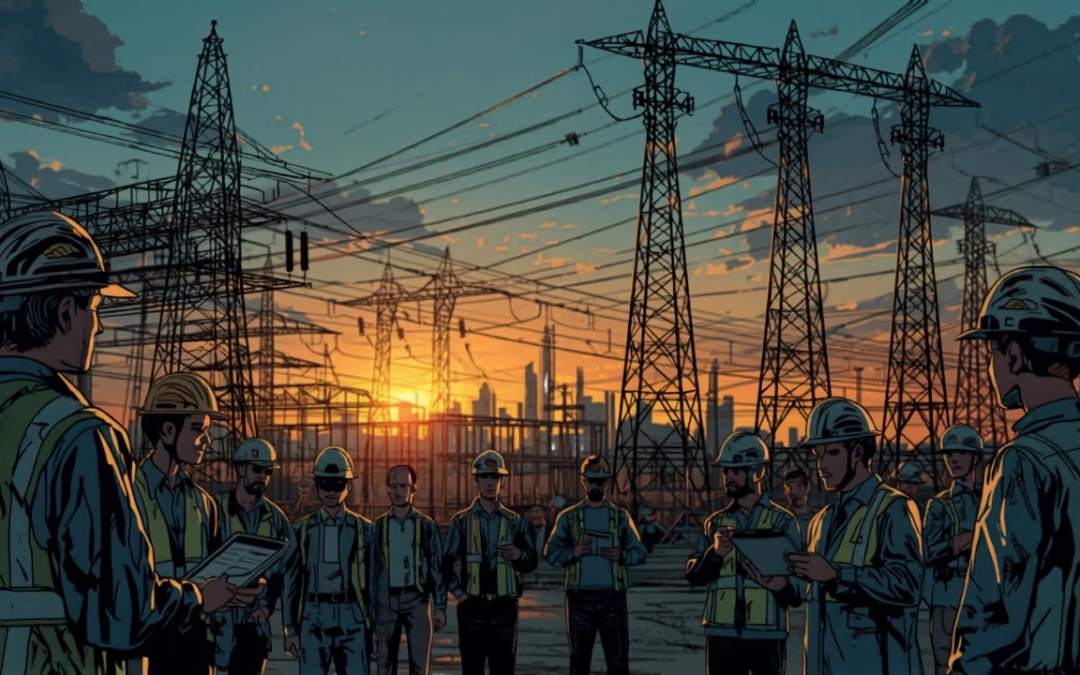
Houston is the energy capital of the United States in the traditional sense — home to the largest concentration of oil, gas, and petrochemical companies in the world. But it is also, increasingly, the energy transition capital of the country. The same engineering talent base, project management infrastructure, and capital markets ecosystem that built the fossil fuel industry is now being redirected — gradually but unmistakably — toward the infrastructure of the clean energy economy. And nothing in that transition is more consequential, or more understaffed, than the power grid itself.
ERCOT’s grid is under unprecedented strain. The combination of record summer peak demand, the rapid addition of variable generation resources (wind and solar now represent more than 40% of ERCOT’s installed capacity), the retirement of thermal generation assets, and the growing load from data centers and electrification has created a grid that is simultaneously more complex, more stressed, and more dependent on skilled engineering and operations talent than at any point in its history. The buildout required to modernize ERCOT’s transmission infrastructure, add grid-scale storage, and integrate the next generation of renewable resources is a multi-decade, multi-hundred-billion-dollar undertaking that will require a sustained flow of power systems engineers, transmission planners, substation engineers, protection and controls specialists, and project managers.
Houston, as the home base of major transmission developers, ERCOT-adjacent engineering firms, and the Texas offices of national utilities, is where a significant share of that talent demand is concentrated.
What is driving grid and transmission hiring in Houston in 2026
ERCOT’s grid improvement plan is creating sustained project demand. Following the February 2021 winter storm event and subsequent PUCT reform, ERCOT and its transmission service providers have accelerated a major grid improvement program that includes new 345kV transmission lines, substation expansions, synchronous condenser installations, and advanced grid management systems. Each of these project types requires specific engineering disciplines — transmission line design, substation civil and electrical engineering, protection and relay engineering — that are in sustained demand.
Competitive Renewable Energy Zones (CREZ) expansion is likely. The original CREZ transmission buildout — completed in the early 2010s — opened West Texas and Panhandle wind resources to ERCOT load centers and created a development boom. Policy discussions around new transmission corridors to support the next generation of solar and storage resources are ongoing, and the engineering and project management talent required to execute a CREZ-scale expansion would represent a significant incremental demand on an already tight market.
Data center load growth is reshaping interconnection economics. The Houston metro and broader Texas market have attracted massive data center investment from hyperscale cloud providers and colocation operators. These loads are large, fast-growing, and technically demanding from an interconnection and grid reliability standpoint. The engineers who can model, plan, and execute the transmission interconnections required to serve multi-hundred-megawatt data center campuses are in direct competition with renewable energy developers for the same talent pool.
The energy transition is creating new roles that did not exist five years ago. Grid modernization at the scale ERCOT requires is not just a matter of building more of what already exists. It requires engineers who understand the interaction of variable renewable resources with grid frequency and voltage stability, who can design and commission advanced inverter-based resource systems, and who can develop the market and operational tools needed to manage a grid with fundamentally different physical characteristics than the one designed around conventional thermal generation. These hybrid technical-analytical profiles are new, rare, and highly valued.
The power grid and transmission roles Houston companies are trying to fill
Transmission line engineer (230kV / 345kV) — Transmission line engineers who can design overhead line structures, conductor selection, right-of-way analysis, and PLS-CADD modeling for high-voltage transmission projects are consistently among the hardest to recruit in Houston’s energy engineering market. The pipeline for this specialty is narrow — it is not a standard university curriculum — and most qualified practitioners developed their expertise through utility or consulting firm apprenticeship over many years.
Substation engineer (civil, electrical, protection and controls) — Substation engineering requires a combination of civil/structural design (foundations, grading, structural steel), electrical design (bus arrangements, equipment specifications, cable and conduit systems), and protection and controls engineering (relay settings, SCADA integration, telecommunications). Specialists in each sub-discipline are independently scarce; the combination is rarer still. Houston’s energy engineering firms are staffing these roles for multiple concurrent utility and transmission developer clients.
Power systems engineer (load flow, stability, protection) — Power systems engineers who can perform load flow studies, dynamic stability analysis, short circuit studies, and protection coordination studies using PSS/E, PowerWorld, or PSCAD are in high demand from ERCOT market participants, transmission developers, and engineering consultancies. The ERCOT-specific modeling environment adds a further knowledge layer that takes time to develop.
Transmission project manager — Project managers who can manage high-voltage transmission projects — including right-of-way acquisition, environmental review, engineering coordination, contractor management, and regulatory interface with ERCOT and transmission service providers — are a specific and valuable profile that combines technical fluency with project execution experience. Senior transmission PMs in Houston typically come from utility backgrounds or large engineering firms and are actively recruited by developers, utilities, and consulting firms simultaneously.
SCADA / energy management systems engineer — The digitalization of the grid — including advanced metering infrastructure, SCADA upgrades, energy management system modernization, and cybersecurity hardening — has created demand for engineers who sit at the intersection of power systems and software/controls. This profile is particularly scarce because traditional power systems engineering programs produce few graduates with meaningful software or controls depth.
Compensation benchmarks for Houston grid and transmission roles, 2026
- Transmission line engineer (5–10 years): $105,000–$145,000
- Substation engineer — electrical (5–10 years): $100,000–$140,000
- Substation engineer — P&C (3–8 years): $105,000–$148,000
- Power systems engineer (PSS/E, 3–8 years): $108,000–$150,000
- Transmission project manager (5–10 years): $120,000–$165,000
- SCADA / EMS engineer (energy sector, 3–8 years): $110,000–$155,000
- Director of transmission development: $175,000–$250,000+
Houston’s energy engineering compensation has been influenced both by the clean energy transition premium and by the oil and gas sector’s competitive response. Engineers with cross-sector experience — who have worked in both conventional and renewable energy infrastructure — command premiums that reflect the genuine scarcity of that breadth.
Why grid and transmission recruiting in Houston requires specialized expertise
The power systems and transmission engineering community in Houston is a professional world unto itself. Engineers who specialize in high-voltage transmission, protection systems, and power systems modeling often have career paths that run through specific utilities (CenterPoint, AEP Texas, Oncor), large engineering firms (Burns & McDonnell, Quanta Services, AECOM), and ERCOT itself. Their professional networks are dense, their technical communities are specific, and the ability to reach them requires familiarity with where they gather, what they value professionally, and how to present an opportunity in terms that resonate with their specific expertise.
Axe Recruiting works with transmission developers, utilities, engineering firms, and independent power producers across the Houston and broader Texas market on power systems, grid modernization, and transmission project recruitment. We bring deep knowledge of the ERCOT technical ecosystem, active networks within the Houston energy engineering community, and a search process calibrated to the technical depth these roles require.
Contact Axe Recruiting to discuss your Houston power grid and transmission recruiting needs.