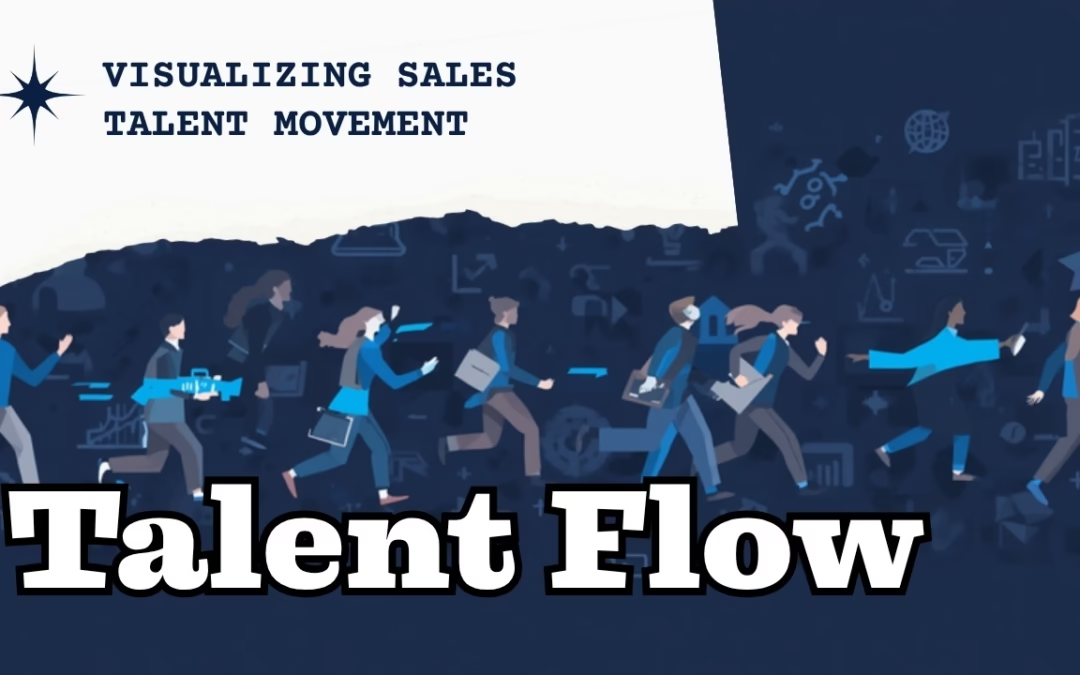
Top sales talent doesn’t distribute evenly across the market. Patterns of where A-players are migrating tell you a lot about which companies are winning the talent war and what they’re doing differently. Understanding the 2026 migration patterns helps companies position themselves competitively — both to recruit top talent and to retain it.
Pattern 1: Top reps are moving toward AI-native companies
The most pronounced 2025-2026 migration: experienced AEs leaving traditional SaaS for AI-native companies (Anthropic, OpenAI, Glean, Hebbia, Harvey, Perplexity, Decagon, Sierra, and a long tail of vertical AI startups). The pull factors are clear:
- Product velocity that produces excitement and clear value propositions
- Buyer demand that meets the rep rather than requiring heavy outbound generation
- Equity packages with credible upside in a generally compressed market
- Career narrative that signals “ahead of the curve” to future employers
- Pricing power that translates into strong commission economics
Traditional SaaS companies hiring AEs are increasingly competing with AI-native offers. The companies that win typically lead with motion quality and stage-appropriate equity rather than trying to match AI-native compensation.
Pattern 2: Mid-stage growth-stage SaaS over later-stage
Top reps are increasingly choosing Series B-C companies over Series D+ and public companies. The reasons:
- Larger territories and clearer attainment paths
- More direct influence on strategy and product feedback
- Equity upside still meaningful at this stage
- Less operational bureaucracy
- Faster decision-making on deals
Series D+ companies and large public companies have started losing competitive battles for top AE talent, especially against well-positioned Series B-C companies with strong commercial momentum.
Pattern 3: Per-Seat-equipped companies attract specialized SDRs
SDRs increasingly select for companies with Per-Seat recruiting infrastructure and structured promotion pathways. The reason: clear visibility into the SDR-to-AE timeline reduces career anxiety. SDRs at companies with documented promotion criteria stay longer and perform better than SDRs at companies with ambiguous paths.
Pattern 4: Revenue-led CS organizations attract revenue-led CSMs
The bifurcation in the CSM market has intensified. Revenue-led CSMs (carrying NRR quotas, owning expansion) increasingly cluster at companies with revenue-led CS positioning. Service-led CSMs (focused on satisfaction and renewals) cluster at companies with traditional CS positioning. The market has segmented more clearly than it did in 2022.
Pattern 5: Hybrid-flexible companies over rigid in-office
Companies demanding 5 days in office for sales teams face a meaningful talent disadvantage in most metros. Top reps increasingly require 2-3 day hybrid or fully remote arrangements. The companies winning the talent war have adapted; the ones holding firm on full in-office have started losing competitive battles even with strong comp packages.
Pattern 6: Specialized vertical experience over generalist experience
Vertical SaaS companies (legal tech, healthcare tech, fintech, construction tech, restaurant tech) are increasingly attracting top reps from generalist horizontal SaaS. The pull factors:
- Deeper buyer relationships that compound over years
- Less commodity competition than horizontal SaaS
- Pricing power from domain expertise
- Stronger personal brand development in a defined community
Top AEs with 5+ years in a specific vertical increasingly stay within that vertical rather than moving horizontally, even when horizontal comp packages are higher.
Pattern 7: Founder-led commercial cultures over functional silos
Top reps increasingly select for companies where the CEO is deeply engaged with commercial strategy. The signal: founders who run pipeline reviews, talk to customers weekly, and treat sales as a strategic priority rather than a cost center. Companies with absentee CEOs and functional sales silos have lost meaningful talent to founder-led commercial cultures.
What companies winning the talent war are doing
- Strong commercial momentum that makes attainment realistic
- Clear comp design with no caps and meaningful accelerators
- Documented career pathways with explicit promotion criteria
- Hybrid or remote-flexible work arrangements
- Founder/CEO engagement with the commercial function
- Investment in modern sales tooling and AI augmentation
- Cultural cohesion that survives quarterly volatility
- Reference relationships with departed reps that produce returning hires
What companies losing the talent war are doing
- Commission caps and aggressive clawback policies
- Quotas disconnected from territory quality
- Rigid in-office requirements without compelling reason
- Founder/CEO disengagement from commercial strategy
- Equity packages calibrated to 2021 valuations
- Process-heavy sales motions that frustrate top performers
- Pattern of cycling through commercial leadership
The mistake to avoid
Competing on headline comp without addressing the structural factors that drive top-rep migration. A $400K OTE package at a company with comp caps, rigid in-office, and absentee leadership loses to a $350K OTE package at a company with uncapped accelerators, hybrid work, and engaged founder. Structure matters more than headlines in the 2026 talent market.
Hiring help
Axe Recruiting works inside the current talent migration patterns.
We help companies position themselves competitively against AI-native, vertical, and growth-stage alternatives \u2014 not just match headline comp.
→ Sales Recruiting
→ Start a conversation
Call (888) 340-3048 · [email protected]